How long should it take to switch a dog to fresh food?
Plan on about 10 days. The American Animal Hospital Association (AAHA) advises moving dogs to any new food “over seven days,” starting by replacing 25% of the old food and increasing it based on how your dog takes it (AAHA, 2021).
We add three days for fresh food because the jump is bigger than a switch between two kibbles. The water content, fat level and texture all change at once. Ten days costs you little and gives a sensitive gut more time.
Why not switch your dog's food overnight?
Because a dog's gut reacts to a new diet within days, and stools often loosen first. In a 2022 University of Illinois study, 12 adult beagles were switched abruptly from kibble to a new diet (Lin et al., 2022).
Their fecal scores rose quickly, meaning looser stools, after both diet changes. The chemical products of their gut bacteria shifted within about 2 days, and the bacterial community itself took about 6 days to settle. The study didn't test a gradual switch, so it can't tell us how much stepping down helps. But it shows the gut needs most of a week to adjust, which is exactly the window a gradual switch covers.
What does a 10-day switch to fresh food look like?
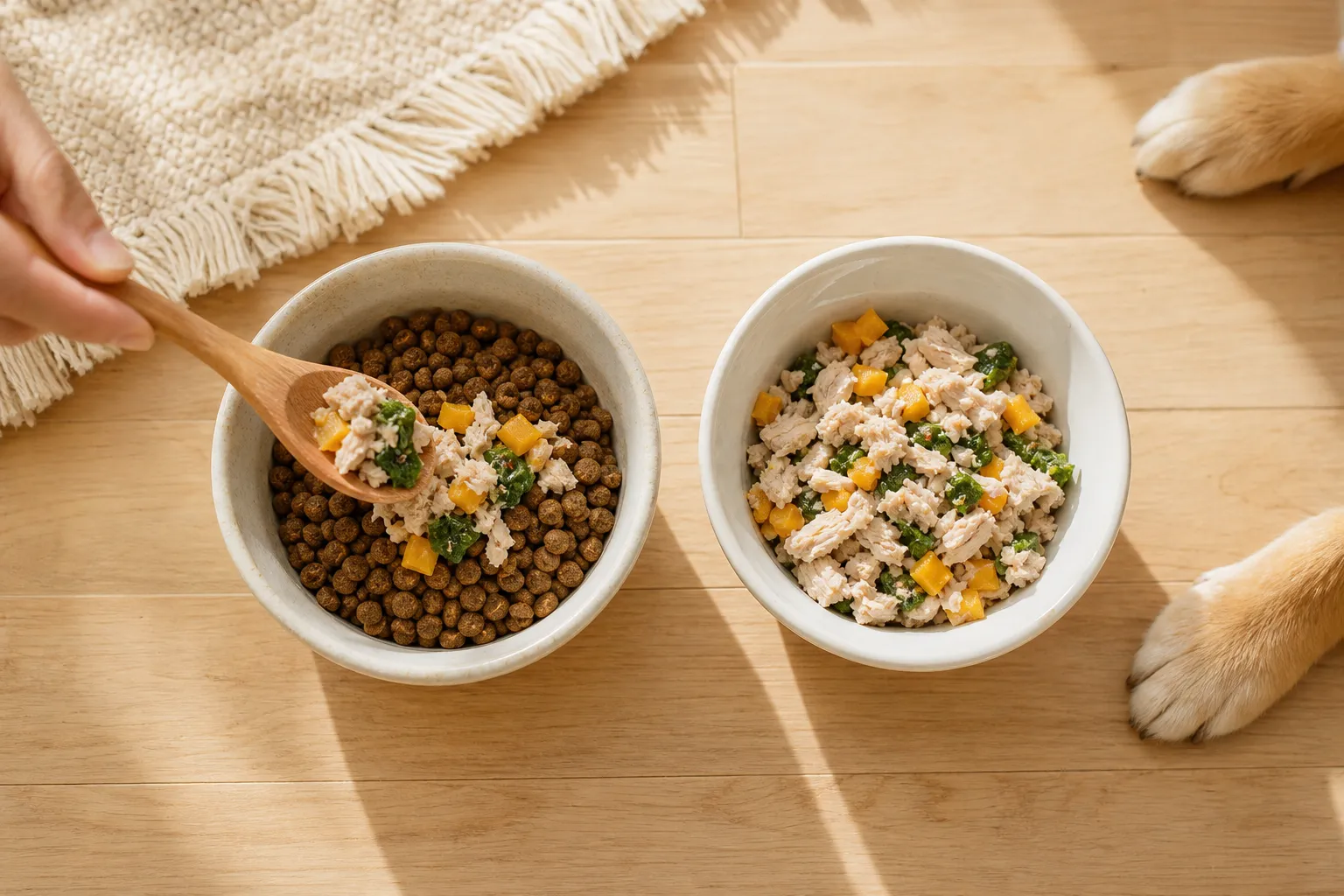
Four steps of roughly three days each, with the fresh share measured in calories. The second column is the one that matters; the grams are an example for a 25 lb (11.3 kg) neutered adult on 692 kcal a day.
| When | Share of daily calories from fresh food | Fresh food (example) | Kibble (example) |
|---|---|---|---|
| Days 1-3 | 25% fresh, 75% old food | 133 g | 144 g |
| Days 4-6 | 50% fresh, 50% old food | 266 g | 96 g |
| Days 7-9 | 75% fresh, 25% old food | 399 g | 48 g |
| Day 10 onward | 100% fresh, 0% old food | 532 g | None |
Example uses illustrative labels: kibble at 3,600 kcal/kg and fresh food at 1,300 kcal/kg. Use the calorie figures on your own bag and packs.
If stools are firm and your dog is eating well at the end of a step, move on. If they're soft, stay where you are for two or three more days. AAHA's advice is the same: increase the new food “based on your pet's acceptance”, not the calendar.
Why should you mix by calories, not cups?
Because fresh food is mostly water, a cup of it carries far fewer calories than a cup of kibble. Swap cup for cup and your dog ends up underfed on fresh food; swap by weight in the other direction and you overfeed the kibble.
In our example, the same 25% of calories is about 48 g of kibble but 133g of fresh food. That's why the fresh portion looks so big, and why a pre-portioned plan helps. Our feeding guide shows how to set the daily total, and fresh vs kibble explains the water difference.
| Dog's weight | Daily calories | 25% fresh (calories) | Fresh food for that 25% (example) |
|---|---|---|---|
| 10 lb (4.5 kg) | 348 kcal | 87 kcal | 67 g |
| 25 lb (11.3 kg) | 692 kcal | 173 kcal | 133 g |
| 50 lb (22.7 kg) | 1,164 kcal | 291 kcal | 224 g |
| 75 lb (34.0 kg) | 1,578 kcal | 395 kcal | 303 g |
Calories from 70 x kg^0.75 x 1.6 (neutered adult). Active dogs need more; less active and senior dogs usually need less.
The Farmer's Dog - Best overall fresh dog food
50% off first box + free treats
- Personalized meal plans for your dog's needs
- Gently cooked fresh food
- Formulated by board-certified nutritionists
- Cancel anytime
- Custom portions
- Ships frozen
Best overall fresh dog food
50% off first box + free treats
- Personalized meal plans for your dog's needs
- Gently cooked fresh food
- Formulated by board-certified nutritionists
- Cancel anytime
- Custom portions
- Ships frozen
What's normal during the switch, and what isn't?
Most changes during a switch are expected. Here's how we'd read them:
| What you see | What it usually means | What to do |
|---|---|---|
| Slightly softer stool for a day or two | The gut is adjusting | Hold the current step for 2-3 more days |
| Smaller, firmer stools after a week | More of the food is being digested | Nothing; this is the goal |
| Drinking a little less water | Fresh food carries much of the day's water | Keep fresh water out as usual |
| Picking out the fresh food first | A preference, not a problem | Keep to the plan's calorie split |
| Diarrhoea that lasts, vomiting, blood, lethargy | More than an adjustment | Stop the switch and call your vet |
When should you switch more slowly?
Take two weeks or more, and talk to your vet first, if your dog has a history of stomach trouble or pancreatitis, is on a prescription diet, or is a senior with health problems. Never swap out a prescription diet without your vet's agreement.
For dogs with delicate digestion, see fresh food for sensitive stomachs. For older dogs, our senior dog guide covers lower calorie needs.
How should puppies switch to fresh food?
The same gradual pattern works, with two extra checks. First, the fresh food must be complete for growth: its AAFCO statement should say “growth” or “all life stages”, not adult maintenance only (how to read the label).
Second, puppies need far more calories per pound than adults, so total daily calories must stay at the puppy level throughout. See our guide to fresh food for puppies for the growth rules and calorie numbers.
What if your dog won't eat the fresh food?
Picky eating is one of the most common reasons owners try fresh food in the first place. If yours hesitates, keep the share of new food small for longer and let acceptance set the pace.
AAHA suggests simple flavour helpers for dogs during a switch, such as a little low-salt chicken or beef broth (AAHA, 2021). Our picky eater guide covers which brands fussy dogs tend to prefer.
How should you thaw and store fresh food during the switch?
Keep packs frozen until you need them, and thaw the next day's portions in the fridge, not on the counter. Cover and refrigerate anything your dog leaves, or throw it out. Those are the FDA's standard pet food handling steps, and it advises following them “no matter what type of pet food you feed” (FDA).
Wash bowls after each meal and your hands after handling the food. If you're considering raw rather than cooked fresh food, read is raw dog food safe? first.
What happens after the switch?
Weigh your dog and check its body condition two to four weeks in. If it's gaining or losing, adjust the daily calories in small steps and re-check after a couple of weeks. Fresh plans portion to a starting estimate, not a guarantee.
You don't have to go 100% fresh. Many owners stop at a fresh topper or a mixed plan to control cost; is fresh dog food worth it? covers the trade-off. To choose a brand, start with our 2026 ranking or The Farmer's Dog vs Ollie.

Ollie - Best for mixing fresh and baked
70% off 1st box + free gift
- Made with human-grade ingredients
- Vet-formulated & personalized meals
- 100% satisfied or money-back guarantee
- Cancel anytime
- Custom portions
- Frozen or dry
Best for mixing fresh and baked
70% off 1st box + free gift
- Made with human-grade ingredients
- Vet-formulated & personalized meals
- 100% satisfied or money-back guarantee
- Cancel anytime
- Custom portions
- Frozen or dry