
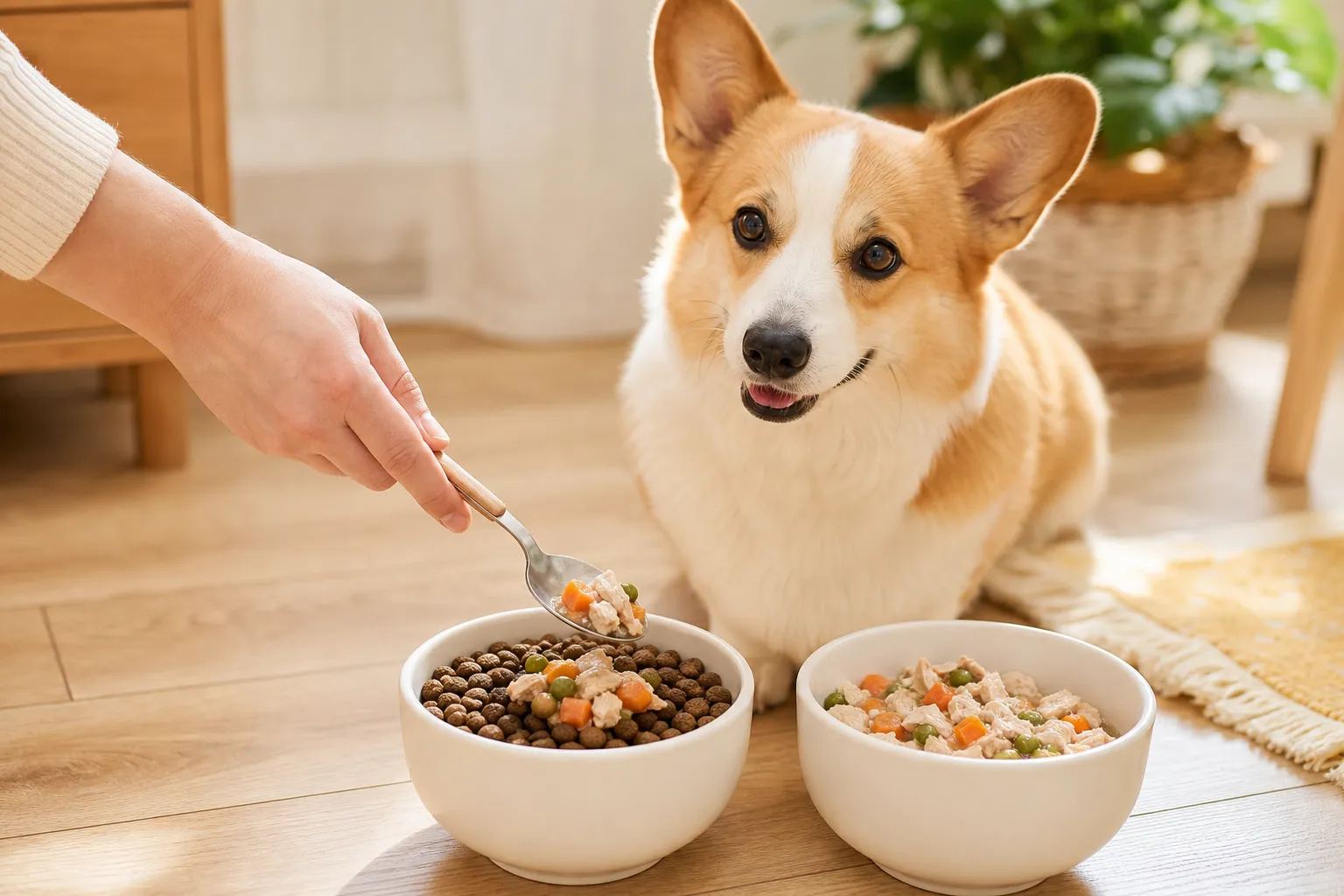
What's the difference between a fresh topper and a full fresh meal?
The share of your dog's daily calories that comes from fresh food. A topper supplies a slice of the day's energy and the base food supplies the rest; a full fresh diet supplies all of it.
There's no official cut-off between “topper” and “mixed”, so we use four practical splits. What changes between them is cost, how much the label matters and how much of the fresh-food effect your dog is likely to get.
| Split | Fresh share of calories | What it means |
|---|---|---|
| Garnish | 10% | A spoonful for taste; fits inside the treat allowance |
| Topper | 25% | The most common split; kibble still does most of the work |
| Half and half | 50% | A true mixed diet; both foods should be complete |
| Full fresh | 100% | Fresh food is the whole diet; must be complete for the life stage |
Shares are of total daily calories. Cost of the fresh part scales with the share: a 25% topper costs about a quarter of a full fresh plan for the same dog, plus the kibble.
How do you split calories between fresh food and kibble?
Work out your dog's daily calories, take your chosen share as fresh food, and give the rest as kibble. Then convert each part to grams with its own label's calorie figure.
- Estimate daily calories: 70 x (weight in kg to the power 0.75), times 1.6 for a typical neutered adult. A 25 lb (11.3 kg) dog comes to about 692 kcal. Our feeding guide covers other life stages.
- Pick the fresh share: 10%, 25%, 50% or 100%. At 25%, that's 173 kcal of fresh food and 519 kcal of kibble.
- Convert to grams: kcal divided by the label's kcal per kg, times 1,000. At 1,300 kcal/kg, 173 kcal of fresh food is about 133 g.
- Cut the kibble by the same calories. At 3,600 kcal/kg, the remaining 519 kcal is about 144 g, down from 192 g.
The WSAVA describes the same method for any food: divide the energy need by the food's calorie density (WSAVA). The only change for a split is doing it twice, once per food.
| Dog's weight | Daily calories | Fresh food (25%) | Kibble (75%) |
|---|---|---|---|
| 10 lb (4.5 kg) | 348 kcal | 87 kcal = 67 g | 261 kcal = 73 g |
| 25 lb (11.3 kg) | 692 kcal | 173 kcal = 133 g | 519 kcal = 144 g |
| 50 lb (22.7 kg) | 1,164 kcal | 291 kcal = 224 g | 873 kcal = 243 g |
| 75 lb (34.0 kg) | 1,578 kcal | 395 kcal = 303 g | 1,184 kcal = 329 g |
| 100 lb (45.4 kg) | 1,958 kcal | 490 kcal = 377 g | 1,469 kcal = 408 g |
Neutered adults, 70 x kg^0.75 x 1.6. Grams use illustrative labels: fresh food at 1,300 kcal/kg and kibble at 3,600 kcal/kg. Swap in the numbers printed on your own bag and packs.
Why can't you just swap a scoop of kibble for a scoop of fresh food?
Because fresh food is mostly water, so the same volume carries far fewer calories. With our example labels, a gram of kibble has about 2.8 times the calories of a gram of fresh food.
Replace a scoop of kibble with a scoop of fresh food and the bowl looks just as full but holds fewer calories, so your dog ends up underfed. By weight, 100 g of fresh food stands in for only about 36 g of kibble. Our fresh vs kibble guide explains the water difference.
When does the 10% rule apply to a topper?
When the topper isn't complete and balanced. The WSAVA says foods labelled for “short-term”, “intermittent” or “complementary” feeding should be “a small portion of the diet (10% or less)” (WSAVA, 2021).
In the US, that's the AAFCO statement reading “for intermittent or supplemental feeding only”. Many topper-only products, broths and mix-ins carry it. Our label guide shows where to find the statement.
The reason is dilution. A complete kibble is formulated to deliver its vitamins and minerals at the calories it was designed to be fed at. Replace part of those calories with an incomplete food and the base delivers proportionally less.
| Incomplete topper share | Complete food's share of calories | Its vitamins and minerals delivered, vs feeding it alone |
|---|---|---|
| 10% | 90% | About 90% |
| 25% | 75% | About 75% |
| 50% | 50% | About 50% |
Simplified illustration: assumes the topper adds no meaningful vitamins or minerals and total calories stay the same. A complete and balanced topper doesn't dilute the diet in this way.
Treats share the same 10% budget. The WSAVA says treats should be “no more than about 10%” of a dog's daily calories (WSAVA). An incomplete topper plus a handful of training treats can pass that line quickly.
What happens if you add a topper without cutting the kibble?
Your dog eats more calories every day. A 25% topper added on top of a full bowl is a 25% calorie surplus: about 173 kcal a day for a 25 lb dog, or about 5,190 kcal a month.
| Dog's weight | 10% topper added on top | 25% topper added on top |
|---|---|---|
| 10 lb | +35 kcal a day | +87 kcal a day |
| 25 lb | +69 kcal a day | +173 kcal a day |
| 50 lb | +116 kcal a day | +291 kcal a day |
| 75 lb | +158 kcal a day | +395 kcal a day |
Neutered adults, 70 x kg^0.75 x 1.6. Surplus calories are the topper's own calories when nothing is taken away.
Calorie formulas are only a starting point anyway. The WSAVA notes individual dogs can need up to 50% more or less than the estimate, and advises adjusting amounts every 2 weeks at first to reach an ideal weight and body condition (WSAVA). If weight is already a concern, see weight management.
The Pets Table - Best flexible plan mix
50% off 1st box + 20% off 2nd box
- Fresh, air-dried, mixed & topper plans
- Formulated with board-certified vet nutritionists
- Multiple recipes to rotate
- Cancel anytime
- Custom portions
- Frozen or dry
Best flexible plan mix
50% off 1st box + 20% off 2nd box
- Fresh, air-dried, mixed & topper plans
- Formulated with board-certified vet nutritionists
- Multiple recipes to rotate
- Cancel anytime
- Custom portions
- Frozen or dry
How accurate are the calorie numbers on fresh dog food?
They're estimates, and the estimating method matters. In a 2021 study, the calculation methods commonly used for pet food misjudged the measured energy of both kibble and fresh food (Tanprasertsuk et al., 2021).
For the kibble, the modified Atwater method underestimated its energy. For the fresh recipes, no single method fitted all four: the best formula depended on the recipe's fat and protein levels. The authors were employees of, or held stock in, the fresh food company NomNomNow.
In practice, that's one more reason to treat any split as a first guess. Feed it for two weeks, check weight and body condition, and move the calories by small steps.
Does a topper give your dog the benefits of fresh food?
We don't know how much, because the research tested full fresh diets, not toppers. We searched for a published trial of a fresh topper on kibble and found none.
The full-diet results are clear enough. In the 2021 study above, dogs eating a chicken-based fresh diet produced 24 g of fecal dry matter a day against 47 g on a chicken-based kibble, and defecated 1.2 vs 1.7 times a day (Tanprasertsuk et al., 2021). The groups were small, with 6 to 12 dogs per diet, fed for 10 days.
| Measure (per dog, per day) | Fresh diet | Kibble |
|---|---|---|
| Defecations | 1.2 | 1.7 |
| Fecal dry matter | 24 g | 47 g |
| Calories lost in feces | 92 kcal | 189 kcal |
Tanprasertsuk et al., Translational Animal Science, 2021. 12 dogs per chicken diet, 10 days, comparable calorie intakes. Industry-funded (NomNomNow). Toppers were not tested.
It's reasonable to expect a 25% topper to move these numbers less than a full switch, but that's our inference, not a finding. What a topper reliably delivers is taste and moisture, which is often the point for a picky eater.
Which split is right for your dog?
There's no single right split; it depends on budget, your dog's size and why you're adding fresh food at all. Here's how we'd call common situations.
| Your dog or goal | Split we'd start with | Why |
|---|---|---|
| Picky eater on kibble | 10-25% | Taste is the goal; a small share may be all it takes |
| Large dog on a budget | 25% | At 1,578 kcal a day for 75 lb, a full fresh diet is a major cost |
| Small dog | 50-100% | Needs only about 348-585 kcal a day, so full fresh costs least here |
| Needs to lose weight | 100% (portioned) | Pre-portioned packs make the calorie target easier to hit |
| Growing puppy | Any, if both are complete for growth | Both foods must meet AAFCO growth or all-life-stages |
| Prescription diet | None without your vet | Adding food dilutes a therapeutic diet |
Puppies need extra care with any split, because an incomplete topper dilutes the calcium and phosphorus a growth formula is built around. See fresh food for puppies, and our budget guide for the cost side.
How do you start a topper or mixed plan?
Introduce the fresh food gradually, even at 25%. The AAHA advises switching a dog over seven days, starting by replacing 25% of the old food (AAHA, 2021), and the WSAVA says at least 3 days for healthy pets, longer for dogs with disease (WSAVA).
For a 25% topper, that means building up to the full fresh share over about a week. The WSAVA notes that in dogs the two foods can usually be mixed in the same bowl. For a full switch, follow our 10-day plan.
Which fresh dog food brands sell topper or mixed plans?
Among the seven brands we review, plan menus differ more than recipes do. The Pets Table sells an explicit topper plan alongside fresh, air-dried and mixed plans.
Ollie mixes fresh and baked food in one subscription, and Spot & Tango pairs fresh with its fresh-dry UnKibble. The Farmer's Dog is full-meal fresh only, though you can still feed part of a plan and cut the kibble yourself.
Compare plan menus head to head in The Farmer's Dog vs The Pets Table and Ollie vs The Pets Table. Our hubs on fresh toppers and mixed feeding list the options, and is fresh dog food worth it? covers the cost decision.

Ollie - Best for mixing fresh and baked
70% off 1st box + free gift
- Made with human-grade ingredients
- Vet-formulated & personalized meals
- 100% satisfied or money-back guarantee
- Cancel anytime
- Custom portions
- Frozen or dry
Best for mixing fresh and baked
70% off 1st box + free gift
- Made with human-grade ingredients
- Vet-formulated & personalized meals
- 100% satisfied or money-back guarantee
- Cancel anytime
- Custom portions
- Frozen or dry