
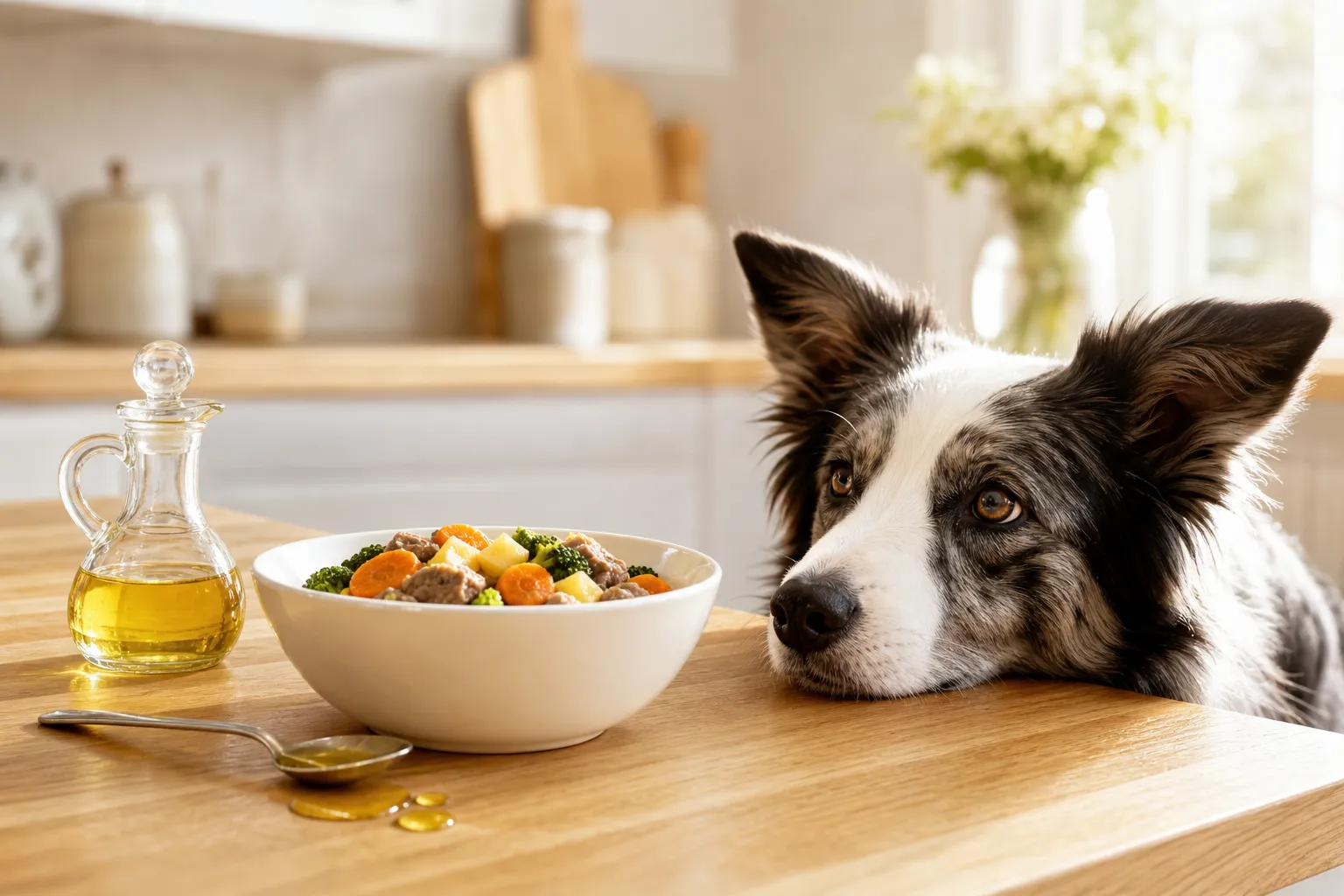
How much fat does a dog need?
At least 13.8 g per 1,000 kcal for adults and 21.3g for puppies. These are AAFCO's minimums behind every “complete and balanced” claim; AAFCO sets a floor for fat, not a ceiling, for healthy dogs.
| Life stage | Per 1,000 kcal | Dry-matter basis |
|---|---|---|
| Adult maintenance | 13.8 g | 5.5% |
| Growth and reproduction (and all life stages) | 21.3 g | 8.5% |
Dry-matter percentages assume 4,000 kcal per kg of dry matter. Fat also carries the essential fatty acids dogs can't make.
Why does fat matter so much for calories?
Because a gram of fat carries about 8.5 kcal, against about 3.5 kcal for protein or carbohydrate, using the modified Atwater factors standard for pet food. A small change in fat moves a food's calories a lot.
Sundays shows this on its own labels, listing calories per cup by source (Sundays):
| Recipe | Calories per cup | From fat | From protein | From carbs |
|---|---|---|---|---|
| Beef | 650 kcal | 400 kcal (62%) | 191 kcal (29%) | 59 kcal (9%) |
| Turkey | 640 kcal | 330 kcal (52%) | 207 kcal (32%) | 103 kcal (16%) |
| Chicken | 620 kcal | 245 kcal (40%) | 241 kcal (39%) | 134 kcal (22%) |
Brand's calculated values, read November 16, 2026. Sundays' fish recipe isn't shown: its listed parts don't add up to its total.
The beef recipe gets 62% of its calories from fat; the chicken recipe 40%. Same brand, same format, a big difference in how energy-dense each scoop is.
How do you compare fat between foods?
Convert the label to grams per 1,000 kcal: fat % x 10,000 / kcal per kg. That removes the effect of water, so fresh, dried and kibble foods compare fairly. Our label guide covers the method, and protein per 1,000 kcal uses the same formula.
How much fat is in real dog foods?
| Food | Fat (min, as fed) | Calories | Fat per 1,000 kcal | x AAFCO adult minimum |
|---|---|---|---|---|
| Spot & Tango UnKibble Beef + Barley | 27% | 4,792 kcal/kg | 56.3 g | 4.1x |
| Spot & Tango UnKibble Turkey + Sweet Potato | 20% | 4,367 kcal/kg | 45.8 g | 3.3x |
| Spot & Tango UnKibble Cod + Salmon | 15% | 4,193 kcal/kg | 35.8 g | 2.6x |
| Sundays Beef (air-dried) | 25% | 5,417 kcal/kg | 46.2 g | 3.3x |
| Sundays Turkey (air-dried) | 22% | 5,333 kcal/kg | 41.3 g | 3.0x |
| Sundays Chicken (air-dried) | 18% | 5,124 kcal/kg | 35.1 g | 2.5x |
From each brand's recipe page, November 16, 2026. Sundays kcal/kg calculated from its kcal per cup and cup weight. Guaranteed analysis is a minimum, so true fat can be higher.
Every food clears the minimum by a wide margin. Within one brand the spread is large: Spot & Tango's Beef + Barley carries 56 g per 1,000 kcal against 36 g for Cod + Salmon.

Spot & Tango - Best fridge-free fresh option
50% off your first order
- Personalized plans by vet nutritionists
- UnKibble™ Fresh Dry meals: no fridge required
- 100% whole food, human-grade ingredients
- Cancel anytime
- Custom portions
- Frozen or dry
Best fridge-free fresh option
50% off your first order
- Personalized plans by vet nutritionists
- UnKibble™ Fresh Dry meals: no fridge required
- 100% whole food, human-grade ingredients
- Cancel anytime
- Custom portions
- Frozen or dry
When is fat too much for a dog?
When it adds calories your dog doesn't burn. Overfeeding is already the norm: 59% of dogs were classified as overweight or obese in the 2022 APOP survey (APOP). Rich food makes small portion errors costlier; use a body condition score check to see where your dog stands.
For a 50 lb adult on about 1,164 kcal a day, a scoop just 10% too big adds about 116 kcal daily. The WSAVA notes real needs vary by up to 50% either side of formula estimates, and advises adjusting every 2 weeks at first (WSAVA).
How do you lower the fat in your dog's diet?
- Pick a leaner recipe in the same brand. Compare fat per 1,000 kcal; poultry and fish recipes were leaner than beef in the foods above.
- Measure every meal. Use the brand's scoop or a kitchen scale; see how much to feed.
- Count treats and toppers. The WSAVA says treats should stay under about 10% of daily calories (WSAVA).
- Skip fatty table scraps. Fatty leftovers are the easiest way to add fat and calories without noticing.
For weight goals, see weight management and our senior dog guide, as older dogs often need fewer calories.
The Farmer's Dog - Best overall fresh dog food
50% off first box + free treats
- Personalized meal plans for your dog's needs
- Gently cooked fresh food
- Formulated by board-certified nutritionists
- Cancel anytime
- Custom portions
- Ships frozen
Best overall fresh dog food
50% off first box + free treats
- Personalized meal plans for your dog's needs
- Gently cooked fresh food
- Formulated by board-certified nutritionists
- Cancel anytime
- Custom portions
- Ships frozen
Pre-portioned fresh plans take the guesswork out of fat and calories. Compare them in our 2026 ranking.