
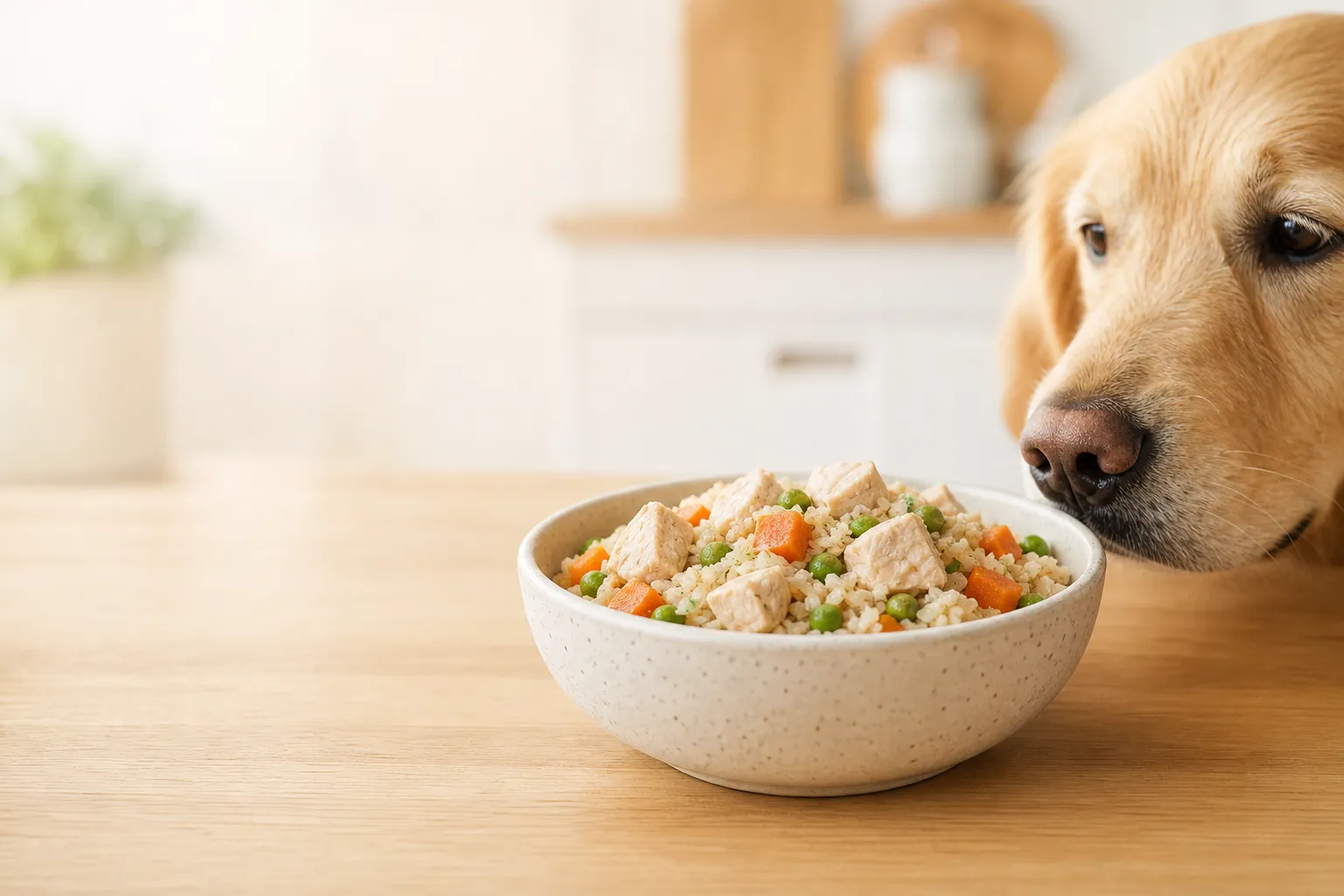
Fresh dog food has gone from a niche to a mainstream choice in a few years, and the questions people ask about it have multiplied with it. We studied more than 2,200 real search queries about fresh dog food and built this guide to answer the ones that come up most: cost, brands, safety, feeding and where to buy.
It's long because the subject is. Use the contents to jump to what you need; every section answers its question in the first sentence and links to a deeper guide where we have one.
Part 1 · The basics
What is fresh dog food?
Fresh dog food is dog food made from whole meat, vegetables and grains or legumes, cooked lightly or not at all, and kept cold rather than dried into kibble. Most of it arrives frozen at your door on a subscription, portioned for your dog's calorie needs.
That last part matters as much as the ingredients. A fresh plan usually starts with a questionnaire about your dog's weight, age, activity and body shape. The brand turns that into a daily calorie target and ships packs sized to it. You thaw, open and serve. There is no scoop and no guessing, which is where a lot of overfeeding starts.
The term isn't legally defined, so “fresh” covers a wide range of products. Some are gently cooked meals that look like a home-cooked stew. Others are raw, freeze-dried, air-dried or baked. When people say “fresh dog food” they usually mean the first group: gently cooked, refrigerated or frozen, and delivered.
This guide covers all of it: what fresh food is, what the research shows, what it really costs, where to buy it, how much to feed, and the safety questions worth asking. Every number comes from a named source we read, or from the standard calorie formulas vets use. Where the evidence is thin, we say so.
What types of fresh dog food are there?
There are eight common formats, and they differ in processing, storage and safety more than in nutrition. Here is how they compare, and which of the seven brands we cover use each one.
| Format | How it's made | Storage | Brands we cover |
|---|---|---|---|
| Gently cooked | Cooked at lower heat in batches, then frozen or chilled | Freezer, then fridge for a few days | The Farmer's Dog, Ollie, Spot & Tango, The Pets Table |
| Raw (frozen) | Not cooked; ground and frozen | Freezer; thaw in the fridge | We Feed Raw |
| Freeze-dried | Frozen, then water removed under vacuum | Pantry | We Feed Raw, Maxbone |
| Air-dried | Slowly dried with warm air | Pantry | The Pets Table, Redbarn |
| Fresh-dry (no fridge) | Cooked, then dried into bite-size pieces | Pantry | Spot & Tango |
| Baked | Baked into kibble-like pieces | Pantry | Ollie |
| Rolled | Cooked and packed into a sliceable log | Pantry until opened, then fridge | Redbarn |
| Topper | Small portions meant to go on another food | Depends on format | The Pets Table |
Brand formats as listed in our brand data. Freeze-dried and air-dried products can be raw or cooked; check the label.
The format decides two practical things: whether you need freezer space, and whether the food has been through a cooking step. The second matters for safety, which we cover in Part 4. If freezer space is the deal-breaker, the pantry formats are the ones to look at; see freeze-dried and air-dried food.
Is fresh dog food cooked or raw?
Most fresh dog food sold by delivery is cooked; raw is a separate category. The Farmer's Dog, Ollie and Spot & Tango's fresh line are gently cooked. We Feed Raw sells raw, and some freeze-dried products are raw too.
The difference is not cosmetic. Cooking kills the bacteria that raw meat can carry, and the FDA's own testing found raw pet food far more likely to be contaminated (more in Part 4). If a product doesn't say “cooked” on the pack, assume it may be raw and handle it like raw meat.
How is fresh dog food different from kibble?
The real differences are processing and water. Kibble is made by forcing a cooked dough through an extruder, then drying it. Research on canine diets describes extrusion temperatures of 110-150 °C, or 230-300 °F (Tran, Wageningen University, 2008). Fresh food is cooked at lower heat and keeps most of its water.
| Kibble | Gently cooked fresh food | |
|---|---|---|
| Processing | Extruded at high heat and pressure, then dried | Cooked at lower heat, then frozen or chilled |
| Water content | About 10% | About 70% |
| Bowl size for the same calories | Small | Two to three times bigger by weight |
| Storage | Pantry for months | Freezer, then fridge for a few days |
| Portioning | You scoop and estimate | Usually pre-portioned to a calorie target |
| Completeness | Only if the AAFCO statement says so | Only if the AAFCO statement says so |
| Cost per calorie | Lower | Higher |
Moisture figures are typical ranges; check the guaranteed analysis on the food you buy.
The water is why fresh labels can look low in protein. A food that's 70% water and 11% protein as fed is about 37% protein once you remove the water, well above most kibble. Our fresh vs kibble guide walks through that conversion and everything else that changes for your dog after a switch.
Is fresh dog food healthier than kibble?
It's more digestible in the studies we have, but no study has shown it makes dogs live longer or get sick less often. That's the honest summary, and it's worth understanding both halves.
The best evidence comes from two University of Illinois trials. Both are small, both were funded by fresh-food companies, and both measured digestion over weeks rather than health over years.
| Study | Dogs and diets | Main finding | Limits |
|---|---|---|---|
| Do et al., 2021 | 12 beagles; kibble vs one fresh refrigerated and two fresh human-grade diets, 4 weeks each | Kibble-fed dogs ate more to hold their weight and produced 1.5-2.9x more stool | One breed, short; funded by a fresh-food company |
| Algya et al., 2018 | 8 adult dogs; kibble vs two mildly cooked diets and a raw diet | Mildly cooked diets had higher protein and fat digestibility than kibble | Small; funded by Freshpet, whose diets were tested |
Funding of the 2021 trial as reported by Veterinary Practice News.
More digestible means more of the food is absorbed and less comes out the other end. Owners notice it as smaller, firmer stools. That's a real benefit, but it isn't the same thing as better long-term health.
Two other effects are better supported in practice than in trials. Fresh food is far more palatable to many dogs; of the 282 Trustpilot reviews we read for our brand reviews, 39 (14%) mention a picky or fussy eater. And pre-portioned packs make it much easier to keep a dog lean. In the Association for Pet Obesity Prevention's 2022 survey, vets rated 59% of US dogs overweight or obese (APOP, 2022).
Do vets recommend fresh dog food?
There's no blanket veterinary position for or against cooked fresh food. The major bodies focus on two things: that the diet is complete and balanced, and that it isn't raw.
The World Small Animal Veterinary Association (WSAVA) says your dog should eat a complete and balanced diet for its life stage “from a reputable company,” and that “your veterinarian is the best person to ask about the best diet for your pet” (WSAVA). On raw food the positions are firmer: the American Veterinary Medical Association discourages feeding any raw or undercooked animal protein (AVMA).
So a vet is likely to be comfortable with a cooked fresh diet that carries a complete AAFCO statement for your dog's life stage, and wary of raw. Bring the label to your next checkup; it's a five-minute conversation.
What does “human-grade” dog food mean?
“Human-grade” means every ingredient and the finished food are edible for people, and were made, stored and transported under human-food rules. A single non-human-grade ingredient, or a pet-food-only facility, rules the claim out.
It's a safety and handling standard, not a nutrition score. A human-grade food can still be unbalanced, and a feed-grade food can be complete. Treat it as one point in a brand's favour, not the reason to buy. See human-grade dog food and our label guide for the full definition.
Is fresh dog food complete and balanced?
Only if its label says so. Look for the AAFCO nutritional adequacy statement: it should say the food is complete and balanced for your dog's life stage, either by formulation or by feeding trials.
The WSAVA's checklist for choosing any food starts here. It also notes that diets labelled “for all life-stages” are formulated for reproduction and growth, and that foods for “intermittent” or “complementary” feeding should make up 10% of the diet or less (WSAVA, 2021).
| Check | What to look for | Why |
|---|---|---|
| AAFCO statement | Complete and balanced for your dog's life stage | Without it, the food isn't a full diet |
| Life stage | Growth or all life stages for puppies; adult maintenance for adults | Puppies have higher minimums |
| Large-size growth | "Including growth of large size dogs (70 lb or more as an adult)" | Calcium is capped for big-breed puppies |
| Calories | kcal per kg or per pack | You need it to portion and to compare cost |
| Ingredient list | Named meats first; where peas, lentils or potatoes appear | Relevant to the FDA's DCM reports |
| Cooking | Says cooked, or treat as raw | Raw needs raw-meat handling |
Calorie information is required on pet food labels in the US, the WSAVA notes, which makes cost and portion comparisons possible here in a way they aren't everywhere (WSAVA, 2021).
Is fresh dog food grain-free?
Some recipes are, many aren't, and grain-free isn't automatically better. Fresh brands use rice, oats and barley in some recipes and sweet potatoes, peas or lentils in others.
The question matters because of the FDA's investigation into diet and canine dilated cardiomyopathy (DCM). In the cases it analysed, more than 90% of foods were labelled grain-free and 93% contained peas and/or lentils (FDA). The FDA hasn't found that these diets cause DCM and recalled none, but the pattern points at peas, lentils and other pulses high on the ingredient list, not at the absence of grain. We cover it in Part 4 and in depth in grain-free dog food and DCM.
- No medical reason to avoid grain? A grain-inclusive recipe sidesteps the question.
- Feeding grain-free already? Check where pulses sit in the ingredient list and mention the diet to your vet.
- Suspect a grain allergy? Confirm it with your vet before choosing a food on that basis; an elimination diet is the usual way to test.
Part 2 · Cost and buying
How much does fresh dog food cost?
It depends almost entirely on how many calories your dog needs. For The Farmer's Dog, Petful's February 2026 survey testing found prices from about $2.31 to $26.77 a day, from small dogs to giant breeds (Petful, 2026). That is roughly $69.30 to $803.10 for a 30-day month.
The spread looks extreme, but it follows a simple rule: you pay per calorie, and calories rise more slowly than body weight. Energy needs scale with weight to the power of 0.75, so a dog four times heavier needs only about 2.8 times the food.
| Dog's weight | Calories per day | Calories per month | vs a 25 lb dog |
|---|---|---|---|
| 10 lb (4.5 kg) | 348 kcal | 10,440 kcal | 0.50x |
| 25 lb (11.3 kg) | 692 kcal | 20,760 kcal | 1.00x |
| 50 lb (22.7 kg) | 1,164 kcal | 34,920 kcal | 1.68x |
| 75 lb (34.0 kg) | 1,578 kcal | 47,340 kcal | 2.28x |
| 100 lb (45.4 kg) | 1,958 kcal | 58,740 kcal | 2.83x |
Calories from 70 x kg^0.75 x 1.6 (neutered adult). Active dogs need more; seniors and less active dogs usually less.
To estimate your own cost, take the price of a plan or pack, divide by the calories it contains to get a price per 1,000 kcal, then multiply by your dog's daily calories. That single number lets you compare a fresh plan, a bag of kibble and a topper on equal terms. Box prices hide it, because fresh food is mostly water.
Why is fresh dog food so expensive?
Four costs stack up that kibble doesn't carry, or carries far less of:
- You're buying water. At around 70% moisture, fresh food weighs two to three times as much as kibble for the same calories, and every pound has to be made, packed, frozen and shipped.
- Cold shipping. Frozen food travels in insulated boxes with coolant, direct to your door, usually in smaller and more frequent orders than a sack of kibble.
- Ingredients and handling. Whole meats and vegetables, often under human-food handling rules for human-grade claims, cost more than rendered meals and dry starches.
- Per-dog portioning. Each pack is sized to one dog's calorie target, which is labour a bag of kibble doesn't need.
Price is also the most common complaint about fresh food. Of the 282 Trustpilot reviews on our brand review pages, 33 mention price or cost, and several of the most critical ones are about an expensive second box after a cheaper trial. We come back to that in the customer reviews section below.
How much does fresh dog food cost per month?
Multiply your dog's daily calories by 30, then by the price per 1,000 kcal of the food you're quoted. Using Petful's Farmer's Dog range, the monthly bill runs from about $69.30 for a small dog to about $803.10 for a giant breed.
Two things move the number more than the brand does. The first is whether you feed fresh as the whole diet or as part of it. The second is your dog's real calorie need, which can sit well above or below the formula depending on activity and metabolism. Weigh your dog every few weeks after you start and let the plan adjust.
| Plan type | Fresh share of calories | Cost vs full fresh |
|---|---|---|
| Full fresh | 100% | Full price |
| Half and half (mixed) | 50% | About half, plus the kibble |
| Topper | About 25% | About a quarter, plus the kibble |
| Occasional topper or treat | 10% or less | Small; counts toward the treat allowance |
Cost scales with the share of calories, so a 25% topper costs about a quarter of a full fresh plan for the same dog, plus the kibble that makes up the rest.
What's the cheapest way to try fresh dog food?
Start with a trial box or a small bag. These are the lowest-priced ways in that we found in our product listings, captured from Google Shopping on November 5, 2026:
| Product | Brand | Listed price | Sold by |
|---|---|---|---|
| Small Dog Trial Box | The Farmer's Dog | $2.00 | The Farmer's Dog |
| Fresh Food Trial Box | The Farmer's Dog | $14.00 | The Farmer's Dog |
| Fresh Chicken Dish with Carrots | Ollie | $14.00 | Ollie |
| UnKibble, Beef + Barley | Spot & Tango | $15.34 (was $31.00) | Spot & Tango |
| Air-Dried Lamb & Beef with Brown Rice (16 oz (454 g)) | The Pets Table | $17.97 (was $20.00) | Walmart and other retailers |
| Baked Chicken Dish with Carrots (2 lb bag) | Ollie | $18.99 | Petco |
Trial and starter prices usually apply to the first order only; subscription plans are then priced to your dog. Prices change often.
How can you make fresh dog food cheaper?
Feeding fresh doesn't have to mean feeding only fresh. These are the levers that actually change the bill:
- Feed it as a topper. Replace about 25% of your dog's calories with fresh food and cut the kibble by the same number of calories. You keep most of the taste for about a quarter of the cost. See fresh toppers.
- Go half and half. A 50/50 mix halves the fresh bill; our mixed feeding guide covers the calorie split.
- Use the shelf-stable lines. Baked, air-dried and fresh-dry formats from the same brands often cost less per calorie than frozen fresh and save freezer space.
- Compare per 1,000 kcal, not per box. It's the only fair comparison across formats and pack sizes.
- Keep your dog lean. An overweight dog eats more calories than it needs; bringing it to a healthy weight cuts the bill and helps the dog.
- Watch intro pricing. Judge a plan on its ongoing price, not the first box.
If you're still deciding whether fresh is worth paying for at all, our is fresh dog food worth it? guide works through it by dog size and situation.
What is the best fresh dog food in 2026?
Our top three, scored with the same published rubric as every brand we cover, are below. The ranking weighs nutrition and formulation (30%), value per 1,000 kcal (20%), safety and transparency, ingredient quality, and plan flexibility (15% each), and convenience (5%), and a lower score is never placed above a higher one (how we rank).
The Farmer's Dog - Best overall fresh dog food
50% off first box + free treats
- Personalized meal plans for your dog's needs
- Gently cooked fresh food
- Formulated by board-certified nutritionists
- Cancel anytime
- Custom portions
- Ships frozen
Best overall fresh dog food
50% off first box + free treats
- Personalized meal plans for your dog's needs
- Gently cooked fresh food
- Formulated by board-certified nutritionists
- Cancel anytime
- Custom portions
- Ships frozen

Ollie - Best for mixing fresh and baked
70% off 1st box + free gift
- Made with human-grade ingredients
- Vet-formulated & personalized meals
- 100% satisfied or money-back guarantee
- Cancel anytime
- Custom portions
- Frozen or dry
Best for mixing fresh and baked
70% off 1st box + free gift
- Made with human-grade ingredients
- Vet-formulated & personalized meals
- 100% satisfied or money-back guarantee
- Cancel anytime
- Custom portions
- Frozen or dry

Spot & Tango - Best fridge-free fresh option
50% off your first order
- Personalized plans by vet nutritionists
- UnKibble™ Fresh Dry meals: no fridge required
- 100% whole food, human-grade ingredients
- Cancel anytime
- Custom portions
- Frozen or dry
Best fridge-free fresh option
50% off your first order
- Personalized plans by vet nutritionists
- UnKibble™ Fresh Dry meals: no fridge required
- 100% whole food, human-grade ingredients
- Cancel anytime
- Custom portions
- Frozen or dry
Torn between the top two? The Farmer's Dog vs Ollie breaks it down. No freezer space? Ollie vs Spot & Tango covers the fridge-free option. All seven brands are in our full 2026 ranking.
How do the main fresh dog food brands compare?
Here are the seven brands we cover, side by side on the things that differ most between them:
| Brand | Formats | Subscription required | Storage | Our score |
|---|---|---|---|---|
| The Farmer's Dog | Gently cooked | Yes | freezer + fridge | 9.7/10 |
| Ollie | Gently cooked, Baked | Yes | freezer + fridge or pantry | 9.4/10 |
| Spot & Tango | Gently cooked, Fresh-dry (no fridge) | Yes | freezer + fridge or pantry | 9.0/10 |
| We Feed Raw | Raw (frozen), Freeze-dried | Yes | freezer + fridge or pantry | 8.8/10 |
| Maxbone | Freeze-dried | Verifying | pantry | 8.6/10 |
| The Pets Table | Gently cooked, Air-dried, Topper | Yes | freezer + fridge or pantry | 8.5/10 |
| Redbarn | Air-dried, Rolled | No | pantry | 8.2/10 |
Scores from our published rubric. 'Verifying' means we haven't yet confirmed the detail against the brand's own information.
The biggest practical split is storage. Frozen fresh needs freezer space; the pantry formats don't. The second is commitment: most fresh plans are subscriptions, while some brands sell through retailers. Prices and calorie data are being verified brand by brand, and every review page shows them as soon as they're confirmed.
What do customers say about fresh dog food?
Mostly good things about taste and service, and mostly complaints about price and subscriptions. We read every review on the first pages of four brands' Trustpilot profiles, 282reviews in all, and show them on each brand's review page.
| Brand | TrustScore | Reviews on Trustpilot | Reviews we read |
|---|---|---|---|
| The Farmer's Dog | 3.9 / 5 | 1,740 | 62 |
| Ollie | 4.7 / 5 | 11,319 | 100 |
| Spot & Tango | 4.6 / 5 | 2,878 | 60 |
| The Pets Table | 4.4 / 5 | 3,194 | 60 |
TrustScores and review counts as shown on each brand's Trustpilot profile. Review sites are self-selected, and some reviews are invited by the company.
Three themes repeat across brands. Picky and older dogs eating eagerly again is the most common praise. Customer service is praised far more often than criticised, especially around delivery problems. The sharpest complaints are about cost, portion sizes, thawed deliveries, and trial boxes that renewed into full-price subscriptions.
You can read all of them, including every 1- and 2-star review, on our pages for The Farmer's Dog, Ollie, Spot & Tango and The Pets Table.
Can you buy fresh dog food in stores?
Some of it. Most frozen fresh plans are delivery-only, but several brands sell shelf-stable lines, and occasionally frozen packs, through retailers. In our November 5, 2026 product capture, 22 of 40 listings were sold by retailers or marketplace sellers rather than by the brand.
| Seller | What was listed |
|---|---|
| Walmart | The Farmer's Dog Instant Fresh, Chicken & Grain Recipe; The Pets Table Air-Dried Lamb & Beef with Brown Rice |
| Walmart Marketplace (marketplace seller) | The Farmer's Dog Instant Fresh, Chicken & Grain Recipe (bulk); The Farmer's Dog Snap Sticks, Chicken & Apple Recipe |
| Petco | Ollie Baked Chicken Dish with Carrots; Ollie Baked Chicken Dish with Carrots (large bag); Ollie Baked Beef Dish with Sweet Potatoes (large bag); Ollie Chicken & Apple Jerky Strips; Ollie Beef & Sweet Potato Jerky Strips |
| eBay (marketplace seller) | Spot & Tango Snacks: Chicken Bites; Spot & Tango Snacks: Beef Liver Trainers |
| Chewy | The Pets Table Freshly-Made Frozen Chicken Casserole with Green Beans; The Pets Table Freshly-Made Frozen Beef Stew with Carrots; The Pets Table Air-Dried Chicken & Sweet Potato Recipe; The Pets Table Air-Dried Salmon & Whitefish with Pumpkin; The Pets Table Air-Dried Beef & Berries Recipe; Maxbone Muscle Up, Beef Freeze-Dried Recipe; Maxbone Glow Up, Turkey Freeze-Dried Recipe; Redbarn Grain-Free Large Breed Dry Dog Food |
| Pets Are People Too | Redbarn Grain-Free Sky Recipe (poultry) |
| Brothers Country Store | Redbarn Whole Grain Land Recipe |
| PetSupplyWarehouse | Redbarn Grain-Free Dog Food Roll, Chicken Recipe |
Online listings, not a store-stock check. Marketplace sellers are third parties reselling the product; check the brand's own price first.
The listings we captured didn't include Costco or Target, so check those stores directly. If buying in person matters, the retail-first brand in our list is Redbarn, and Ollie's baked food and jerky are sold at Petco.com. Our product carousels list every product we track with its price and seller.
Can you get fresh dog food without a subscription?
Yes, but mostly in shelf-stable formats. Frozen fresh plans are mostly subscriptions; you can usually pause, skip or cancel online, but the default is a recurring delivery.
- Ollie's baked food and jerky treats at Petco.com, no subscription needed.
- The Pets Table's air-dried and frozen recipes through Chewy and other retailers.
- Redbarn's air-dried, kibble and rolled foods through pet retailers.
- Maxbone's freeze-dried recipes through Chewy, and its kibble direct.
- The Farmer's Dog Instant Fresh through Walmart, including third-party sellers.
If you do subscribe, set the delivery interval to match how fast your dog eats and how much freezer you have, and note the cut-off before each charge. Several brands say they email a reminder before each charge, but reviews show it's easy to miss. Our first-time owner guide covers which plans are easiest to manage.
Part 3 · Feeding
How much fresh dog food should I feed my dog?
Feed by calories, not by cups. Work out your dog's daily calorie need, then divide by the food's calories per gram. Most fresh plans do this for you, but it's worth checking the math, especially if you mix foods.
| Dog's weight | Calories per day | Fresh food per day (example) | Kibble per day (example) |
|---|---|---|---|
| 10 lb (4.5 kg) | 348 kcal | 268 g | 97 g |
| 25 lb (11.3 kg) | 692 kcal | 532 g | 192 g |
| 50 lb (22.7 kg) | 1,164 kcal | 895 g | 323 g |
| 75 lb (34.0 kg) | 1,578 kcal | 1,214 g | 438 g |
| 100 lb (45.4 kg) | 1,958 kcal | 1,506 g | 544 g |
Examples use illustrative labels: fresh food at 1,300 kcal/kg and kibble at 3,600 kcal/kg. Use the calorie figure on your own food.
Treat the result as a starting point. Weigh your dog and check its body condition two to four weeks in, then adjust in small steps. Our fresh feeding guide covers breeds and special cases in more detail.
How do you calculate your dog's calories?
Vets use a two-step formula. You can do it on a phone calculator in under a minute:
- Convert your dog's weight to kilograms: pounds divided by 2.2.
- Work out resting energy (RER): 70 x (weight in kg to the power of 0.75). For a 25 lb (11.3 kg) dog that is 433 kcal.
- Multiply by a life-stage factor from the table below. A neutered adult is x1.6, so the same dog needs about 692 kcal a day.
- Divide by the food's calories per gram to get the portion.
| Life stage | Factor x RER | 25 lb dog (example) |
|---|---|---|
| Puppy under 4 months | x3 | 1,298 kcal/day |
| Puppy 4-12 months | x2 | 865 kcal/day |
| Intact adult | x1.8 | 779 kcal/day |
| Neutered adult | x1.6 | 692 kcal/day |
| Active / working (light) | x2 | 865 kcal/day |
| Senior / less active | x1.4 | 606 kcal/day |
| Weight loss (at target weight) | x1 | 433 kcal/day |
Starting estimates only. The weight-loss factor applies to the target weight, not the current one; plan weight loss with your vet.
How do you switch a dog to fresh food?
Gradually, over about 10 days. The American Animal Hospital Association advises moving dogs to any new food over seven days, starting by replacing 25% of the old food (AAHA, 2021). We add a few days for fresh food because water, fat and texture all change at once.
There's a reason to go slowly. In a 2022 University of Illinois study, 12 adult beagles switched abruptly to a new diet had looser stools almost immediately; their gut metabolites shifted within about 2 days and their gut bacteria took about 6 days to settle (Lin et al., 2022).
| Days | Fresh food | Old food | 25 lb dog: fresh grams (example) |
|---|---|---|---|
| 1-3 | 25% | 75% | 133 g |
| 4-6 | 50% | 50% | 266 g |
| 7-9 | 75% | 25% | 399 g |
| 10 on | 100% | 0% | 532 g |
If stools are soft at the end of a step, hold there for two or three days. Diarrhoea that lasts, vomiting, blood or lethargy are reasons to stop and call your vet. The full day-by-day plan is in how to switch your dog to fresh food.
Can you mix fresh dog food with kibble?
Yes, and it's the most affordable way to feed fresh. The rule is simple: split the day's calories, not the cups, and cut the kibble by exactly the calories the fresh food adds.
For a 25 lb dog on 692 kcal a day, a 25% topper is about 173 kcal: roughly 133 g of fresh food (example label), with the kibble reduced by about 48g. If you add fresh food on top without reducing the kibble, you're adding a quarter more calories every day, which is how dogs gain weight on “healthy” toppers.
Make sure the base food is complete. If the kibble carries the AAFCO statement and the fresh food is a small topper, the diet stays balanced. See mixed feeding and fresh toppers.
Is fresh dog food good for puppies?
Yes, if the recipe is complete for growth. Its AAFCO statement must say “growth” or “all life stages”, and include large-size dogs if your puppy will reach 70 lb or more as an adult.
| Nutrient | Growth | Adult maintenance |
|---|---|---|
| Protein (dry matter) | 22.5% | 18% |
| Fat (dry matter) | 8.5% | 5.5% |
| Protein per 1,000 kcal | 56.3 g | 45 g |
| Fat per 1,000 kcal | 21.3 g | 13.8 g |
| Calcium, large-size growth | Max 1.8% DM | n/a |
Puppies need about 3 times their resting energy under 4 months and 2 times from 4 to 12 months. For large breeds, the WSAVA advises portion-controlled feeding for slow weight gain and a body condition score of 4 out of 9, to avoid joint and skeletal problems, and no free feeding (WSAVA). Our fresh food for puppies guide has the full picture.
Is fresh dog food good for senior dogs?
It can be, especially for older dogs that have gone off their food or find kibble hard to chew. Many of the most enthusiastic reviews we read came from owners of dogs aged 10 and older that started eating eagerly again.
Calories usually need to come down. Using the standard factors, a less active senior (x1.4) needs about 13% fewer calories than a neutered adult (x1.6) of the same weight. Fresh plans adjust to updated weight and activity, so tell the brand when your dog slows down. Our senior dog guide covers it.
Older dogs are also more likely to have kidney, liver or heart conditions. If your vet has prescribed a therapeutic diet, keep it; none of the fresh brands we cover sells a prescription diet.
Can fresh dog food help a dog lose weight?
It can, mainly because the portions are measured. Weight is a widespread problem: vets rated 59% of US dogs overweight or obese in the Association for Pet Obesity Prevention's 2022 survey (APOP, 2022).
The usual approach is to feed for the target weight, not the current one. For a dog weighing 50 lb that should weigh 40 lb, the weight-loss estimate is resting energy at 40 lb x1, about 615 kcal a day, against 1,164 kcal to maintain 50 lb. Plan weight loss with your vet, weigh every two weeks, and count treats. See fresh food for weight management.
Does fresh dog food work for small and large dogs?
Yes, but the trade-offs differ. Small dogs eat little in absolute terms, so fresh food costs the least per day and the gap to kibble is smallest. They also burn more energy per pound, so regular meals matter.
Large dogs are where cost bites. A 100 lb dog needs about 1,958 kcal a day, so a full fresh diet is a serious expense; a topper or mixed plan is often the realistic option. Large-breed puppies also need the calcium cap and measured meals described above. See small dogs and large dogs.
Will fresh dog food change my dog's poop?
Usually, yes: expect smaller, firmer stools once your dog adjusts. In the 2021 Illinois trial, dogs on kibble produced 1.5 to 2.9 times as much stool as on fresh diets, because more of the fresh food was absorbed (University of Illinois, 2021).
A few days of softer stool during the switch is common; diarrhoea that lasts is not. Dogs with a history of digestive trouble should switch more slowly; see fresh food for sensitive stomachs.
Will my dog drink less water on fresh food?
Probably. At around 70% moisture, fresh food delivers much of the day's water in the bowl. For a 25 lb dog, about 532 g of fresh food a day (example label) carries roughly 373 g of water, against about 19 g in the equivalent kibble.
Less drinking is expected, not a warning sign. Keep fresh water out at all times, and call your vet about any sudden, large change in thirst on any diet.
How many treats can a dog on fresh food have?
Keep treats and toppers to about 10% of daily calories. The WSAVA says foods meant for intermittent or complementary feeding should make up 10% of the diet or less (WSAVA, 2021). For a 25 lb dog that's about 69 kcal a day.
Part 4 · Safety, storage and alternatives
Is fresh dog food safe?
Cooked fresh food from a reputable brand is as safe as any other complete dog food, provided you handle and store it properly. The bigger safety question is raw food, which carries a documented and much higher pathogen risk.
No format is recall-proof. The FDA notes that “both cooked and raw pet food products are recalled” for reasons including Salmonella and Listeria, and keeps a public list of pet food recalls (FDA). Check it if a food ever seems to make your dog unwell, and sign up for your brand's alerts.
Whatever you feed, the FDA advises the same handling routine “no matter what type of pet food you feed your pet”: wash hands, clean and disinfect surfaces and bowls, thaw in the fridge and refrigerate or discard leftovers. We cover storage below.
Is raw dog food riskier than cooked fresh food?
Yes, measurably. Between 2010 and 2012 the FDA's Center for Veterinary Medicine tested more than 1,000 pet food samples. Raw food was far more likely to carry disease-causing bacteria than any other type (FDA).
| Type of pet food | Samples | Salmonella positive | Listeria monocytogenes positive |
|---|---|---|---|
| Raw pet food | 196 | 15 (7.7%) | 32 (16.3%) |
| Dry dog food | 120 | 0 | 0 |
| Dry cat food | 120 | 1 | 0 |
| Semi-moist dog food | 120 | 0 | 0 |
| Jerky-type treats | 190 | 0 | 0 |
FDA Center for Veterinary Medicine (published as Nemser et al., Foodborne Pathogens and Disease, 2014). Canned food was not tested.
Newer research agrees. A 2018 Dutch study of 35 commercial frozen raw diets found antibiotic-resistant (ESBL) E. coli in 80% of products, Listeria monocytogenes in 54%, E. coli O157:H7 in 23% and Salmonella in 20% (van Bree et al., 2018).
Raw-fed dogs can also carry bacteria into the home without looking ill. In a Canadian trial, 7 of 16 dogs fed Salmonella-contaminated raw food shed Salmonella in their stool within one to seven days, with no signs of illness (Finley et al., 2007).
That's why the American Veterinary Medical Association discourages feeding raw or undercooked animal protein (AVMA), and the WSAVA says there is “no evidence that raw meat-based diets provide health benefits over commercial or balanced homemade cooked diets” (WSAVA). Our full analysis is in is raw dog food safe?
Can raw dog food carry bird flu?
Yes. On January 17, 2025, the FDA required makers of cat and dog food who use uncooked or unpasteurized poultry or cattle ingredients to treat H5N1 as a “known or reasonably foreseeable hazard” in their food safety plans, and reissued the reminder on September 30, 2025 (FDA).
Cats have become severely ill or died after eating contaminated raw food. The FDA says dogs can contract H5N1, usually with mild signs, and that it had not been detected in dogs in the US. It names pasteurizing, cooking and canning as processing steps capable of inactivating the virus, which is another point in favour of cooked fresh food.
Does grain-free fresh dog food cause heart disease?
That hasn't been shown. The FDA investigated reports of dilated cardiomyopathy (DCM) in dogs from 2018 and received 1,382 dog reports between January 2014 and November 2022 (FDA Q&A).
| Finding | Detail |
|---|---|
| Reports, Jan 2014 - Nov 2022 | 1,382 reports of DCM in dogs |
| Reports to Apr 2019 | 515 dog reports; 560 dogs affected; 119 deaths |
| Diets in the reports | More than 90% labelled grain-free; 93% contained peas and/or lentils |
| Grain-containing diets | Also reported; the common factor was pulses high in the ingredient list |
| Recalls | None; FDA has no definitive information the diets are unsafe |
| Status | No further public updates since Dec 23, 2022, pending new science |
Sources: FDA investigation page and FDA Q&A on non-hereditary DCM.
The FDA describes non-hereditary DCM as a complex condition that may involve genetics, underlying illness and diet, and says some dogs fully or partially recovered with a diet change and veterinary care (FDA Q&A). Signs to watch for are decreased energy, coughing, difficulty breathing and collapse. Our grain-free and DCM guide covers what to do, and the DCM concerns page lists the ingredients involved.
How long does fresh dog food last?
Frozen packs keep until their best-by date; once thawed, use them within the window printed on the pack, usually a few days in the fridge. Brands differ, so the pack is the authority, not a general rule.
The FDA's handling steps apply to every pet food (FDA):
- Keep packs frozen until you need them.
- Thaw in the fridge or microwave, never on the counter or in the sink.
- Wash your hands with soap and water for at least 20 seconds after handling food or bowls.
- Clean, then disinfect surfaces and bowls; the FDA's mix is 1 tablespoon of bleach per quart (4 cups) of water.
- Cover and refrigerate leftovers right away, or throw them out.
A practical habit: move tomorrow's packs from the freezer to the fridge each evening. Keep an opened pack sealed or in a lidded container in the fridge.
Fresh vs freeze-dried vs air-dried vs canned: which is better?
None is better in every way; they trade convenience against processing and safety. The table sums up the trade-offs that matter most.
| Format | Freezer needed? | Cooked? | Main trade-off |
|---|---|---|---|
| Gently cooked fresh | Yes | Yes | Closest to whole food; costs the most and needs freezer space |
| Raw frozen | Yes | No | Highest pathogen risk; strict handling needed |
| Freeze-dried | No | Often no | Convenient; freeze-drying doesn't kill all bacteria (WSAVA) |
| Air-dried | No | Varies | Convenient and dense; check whether a kill step is used |
| Canned | No (until opened) | Yes | Canning is a kill step (the FDA lists it as inactivating H5N1); widely available |
| Kibble | No | Yes | Cheapest per calorie; most processed |
Freeze-drying statement from the WSAVA raw diet toolkit; canning as a virus-inactivating step from the FDA's H5N1 update.
If you want fresh-style food without the freezer, look for a cooked shelf-stable format: baked, fresh-dry (UnKibble-style) or canned. If a freeze-dried or air-dried product is raw, treat it with raw-meat hygiene. See freeze-dried, air-dried and fresh vs kibble.
How is fresh dog food different from canned wet food?
Both are cooked and high in moisture; the main differences are processing, storage and where you buy them. Canned food is sealed and heat-sterilised in the can, so it keeps in the pantry until opened. Fresh food is cooked more gently and kept frozen or chilled.
Canning is a genuine kill step: the FDA lists it, alongside cooking and pasteurising, as a process capable of inactivating H5N1 in pet food ingredients (FDA). That makes canned food one of the most convenient safe options for owners who want wet food without a freezer.
| Gently cooked fresh | Canned wet food | |
|---|---|---|
| Cooked | Yes, at lower heat | Yes, sterilised in the can |
| Storage before opening | Freezer | Pantry |
| After opening | Fridge, use within the pack's window | Fridge, covered, use within the label's window |
| Where to buy | Mostly delivery | Almost every store |
| Portioning | Usually pre-portioned per dog | You portion from the can |
| Completeness | Only if the AAFCO statement says so | Only if the AAFCO statement says so |
Nutritionally, the same rules apply to both: compare on a dry-matter or per-1,000 kcal basis and check the AAFCO statement. If a dog loves wet food and the budget won't stretch to fresh, a complete canned food, or canned mixed with kibble by calories, is a perfectly sound choice.
Is homemade fresh dog food better than delivery?
Only if it's properly balanced, which is harder than it looks. The WSAVA warns that home-prepared cooked and raw diets “may have important nutrient deficiencies and excesses,” which is especially harmful to puppies (WSAVA).
Without a recipe designed for dogs, it's easy to miss minerals and vitamins that a simple meat-and-rice mix doesn't supply. If you cook at home, use a recipe formulated for dogs by a board-certified veterinary nutritionist, with the supplement it specifies, and follow it exactly.
On cost, homemade can be cheaper than delivery for a small dog, but the comparison has to include the supplement, your time and the risk of getting it wrong. For most owners, a complete commercial fresh food, or a topper on a complete kibble, is the simpler way to get the same benefits.
Is fresh dog food good for dogs with health conditions?
It depends on the condition, and your vet should lead. Here's how we'd think about the common ones people search for:
| Condition | What to know |
|---|---|
| Sensitive stomach | A consistent recipe and a slower switch are a sensible start; ask your vet if signs persist |
| Pancreatitis | The WSAVA notes high-fat, low-fiber diets can trigger diarrhoea or even pancreatitis in some dogs; ask your vet for a fat target before choosing |
| Kidney disease | Usually managed with a prescription renal diet; don't replace it with a fresh plan without your vet |
| Food allergies | An elimination diet under your vet's guidance is the way to identify the trigger; single-protein fresh recipes can help afterwards |
| Overweight | Portioned plans help; feed for the target weight and count treats |
| Heart disease or DCM | Discuss diet with your vet or cardiologist; see the DCM section above |
General information, not veterinary advice. Conditions that need prescription diets should stay on them unless your vet says otherwise.
Does fresh dog food clean teeth as well as kibble?
Neither cleans teeth much. Most kibble shatters as soon as a dog bites it, so there's little scraping action. Only specific dental diets and chews with tested claims have shown a reduction in plaque or tartar; the Veterinary Oral Health Council lists the ones that met its standard (VOHC).
Brushing and regular dental checks do the real work on any diet. If your dog is on soft fresh food, it's worth adding a VOHC-accepted chew and a brushing routine.
How do you choose a fresh dog food?
Work through these eight questions, in order:
- Is it complete and balanced for my dog's life stage (and large-size growth, for a big-breed puppy)?
- Is it cooked? If not, can my household manage raw-meat hygiene?
- Do I have freezer space, or do I need a pantry format?
- What does it cost per day at my dog's calories, on the ongoing price, not the trial?
- Where do peas, lentils and potatoes sit in the ingredient list?
- Can I pause, skip and cancel online, and when is the charge cut-off?
- Does the brand publish calories, guaranteed analysis and full ingredients per recipe?
- What do recent reviews say about delivery and customer service?
Our brand reviews answer most of these for each brand, and our 2026 ranking scores all seven with a published method. For specific dogs, start with our guides to picky eaters, puppies and senior dogs, or browse ingredients like peas.
How did we research this guide?
We started from the questions people actually ask. We collected more than 2,200 real search queries about fresh dog food from Google's autocomplete suggestions in November 2026, grouped them by intent, and built a section for each major group: cost, brands, reviews, safety, feeding, formats, storage and buying.
We read every primary source cited here directly: FDA pages and recall notices, AVMA and WSAVA policy documents, AAHA guidance, and peer-reviewed studies where they were accessible. Where a study was only available as an abstract or a press summary, we say so in the source list.
Customer data comes from 282 Trustpilot reviews we read and published on our brand pages, and product prices from listings captured on November 5, 2026. Calorie figures use the standard veterinary formula. Brand prices, calorie densities and AAFCO statements are being verified brand by brand, and we show “Verifying” until they are.
Part 6 · Deciding and buying well
Is fresh dog food worth it for your dog?
It's most worth it for small, picky or overweight dogs, and least worth it for large dogs on a tight budget or dogs on a prescription diet. Here's how we'd call it for the most common situations.
| Your dog or situation | Our call | Why |
|---|---|---|
| Small dog (under 20 lb) | Yes | Needs only around 348-585 kcal a day, so the premium is smallest |
| Picky eater | Yes | Palatability is where fresh food is strongest; 14% of the reviews we read mention picky eaters |
| Needs to lose weight | Yes | Portioned packs remove the scoop-and-guess problem |
| Senior that's gone off food | Often | Softer, more aromatic food can restart appetite; adjust calories down |
| Large dog on a budget | Partly | At 1,578 kcal a day for 75 lb, a topper is usually the realistic option |
| No freezer space | Partly | Choose a cooked shelf-stable format instead of frozen |
| Prescription diet | No | Keep the vet diet; none of the brands we cover sells one |
| Home with small children or immunocompromised people | Cooked only | Avoid raw food; cooked fresh is fine |
Our dedicated is fresh dog food worth it? guide works through the same question with the cost math for each dog size.
What should you do if a fresh dog food box arrives thawed?
Don't feed food that arrived warm, photograph the box and packs, and contact the brand straight away. In the reviews we read, brands usually replaced or refunded thawed or late deliveries.
The pattern was consistent across brands. Ollie customers described replacement boxes after defrosted or late deliveries; a Farmer's Dog customer whose box sat at the carrier for five days was refunded; and several reviewers praised fast resends after missed deliveries. Delivery problems were among the most common complaints, but also among the most commonly resolved.
- Check the box as soon as it arrives; most use coolant that keeps packs frozen for a limited time.
- Packs that are still frozen or fridge-cold can go straight into the freezer.
- Packs that are warm, or a box that sat out for a long time, should not be fed; contact the brand.
- Leave delivery instructions if your door is exposed to sun or wildlife; one reviewer in bear country asked for daytime deliveries for exactly that reason.
How does fresh dog food work for more than one dog?
Each dog gets its own calorie target and its own packs, and the cost is simply the sum of the dogs' calories. That per-dog portioning is one of the real advantages of fresh plans in multi-dog homes, where shared bowls make it hard to see who eats what.
| Dogs | Daily calories | Combined |
|---|---|---|
| 10 lb + 25 lb | 348 + 692 kcal | 1,040 kcal |
| 25 lb + 50 lb | 692 + 1,164 kcal | 1,856 kcal |
| 50 lb + 75 lb | 1,164 + 1,578 kcal | 2,742 kcal |
Neutered adults, RER x 1.6. Feed each dog separately so each gets its own portion.
A practical middle ground in mixed-size homes is full fresh for the small dog and a topper for the big one. Feed the dogs apart, at least at first, so the faster eater doesn't finish both bowls. See multi-dog households.
Is Freshpet fresh dog food, and is it cooked?
Freshpet is a refrigerated dog food sold in grocery and pet stores rather than by delivery, and its products are cooked. The 2018 University of Illinois digestibility study, funded by Freshpet, tested two of its “roasted, refrigerated” diets against kibble and a raw diet (Algya et al., 2018).
In that study the mildly cooked diets had higher protein and fat digestibility than the kibble. As with every study in this field, the sample was small and the funder's products were the ones tested, so read it as evidence about digestibility, not about long-term health.
Freshpet isn't one of the seven brands we currently review, so we don't score it. The checks in this guide apply to it like any other food: an AAFCO statement for your dog's life stage, the calories per pack, where pulses sit in the ingredient list, and storage. Refrigerated food needs to stay cold and be used within the window on the pack once opened.
Who regulates fresh dog food?
In the US, the FDA regulates pet food, including fresh food, alongside state feed regulators that typically apply AAFCO's model rules for labels and nutrient profiles. There is no separate category or approval process for “fresh” food.
One FDA rule matters a lot for fresh and raw brands. Under the Food Safety Modernization Act's Preventive Controls for Animal Food (PCAF) rule, certain animal food businesses must have a written food safety plan that identifies “known or reasonably foreseeable hazards” and the controls for them (FDA). In January 2025 the FDA used that rule to require cat and dog food makers using uncooked poultry or cattle ingredients to add H5N1 to their plans.
| Body | Role relevant to fresh dog food |
|---|---|
| FDA (Center for Veterinary Medicine) | Regulates pet food safety; enforces food safety plans under PCAF; publishes recalls and investigations such as DCM |
| State feed control officials | Register products and enforce labelling, usually based on AAFCO's model regulations |
| AAFCO | Sets the model label rules and the nutrient profiles behind "complete and balanced" claims; it doesn't approve products |
| Brands | Must label accurately, meet the nutrient profile they claim, and run their own food safety plans |
Simplified overview. AAFCO and state rules are what make a 'complete and balanced' statement meaningful; check for it on every food.
For you, the practical upshot is that the AAFCO statement and the brand's own transparency do most of the work. A brand that publishes its formulator, its feeding-trial status and its calorie data is easier to trust than one that leans on words like “fresh” and “natural”, which have no nutritional meaning on their own.
What should you ask a fresh dog food brand before buying?
Eight questions separate the brands that publish their homework from those that don't. A good brand answers all of them on its site or by email.
- Is every recipe complete and balanced, and for which life stages (including large-size growth)?
- Was it proven by AAFCO feeding trials or formulated to meet the profile?
- Who formulates the recipes? Look for a board-certified veterinary nutritionist.
- What are the calories per kg or per pack for each recipe?
- Where do pulses like peas and lentils sit in each ingredient list?
- For raw or freeze-dried raw: is there a validated kill step, and how has the brand addressed H5N1 under the FDA's 2025 requirement?
- What's the ongoing price after the trial, and when is the charge cut-off for each delivery?
- What happens if a box arrives thawed or late?
We ask the same questions in every brand review and score the answers in our rubric. Where a brand hasn't published something yet, our pages say “Verifying” rather than guessing. Our label guide shows where to find most of these answers on the pack.
Part 7 · Brands, mistakes and quick reference
Which fresh dog food brands should you know?
These are the seven brands we review, in ranking order. Each profile pulls from our brand data, our product listings and the Trustpilot reviews we captured, so the numbers match what you'll see on each brand's page.
1. The Farmer's Dog: best overall fresh dog food (9.7/10)
The Farmer's Dog is the reference point for gently cooked subscription food: one format, recipes portioned to each dog's calorie target, and a pause/cancel-anytime plan. It ranks #1 because it scores highest on our formulation-transparency and portion-accuracy criteria; the trade-off is storage and the lack of any shelf-stable option.
| The Farmer's Dog | |
|---|---|
| Formats | Gently cooked |
| Storage | freezer + fridge |
| Products we track | 7 (4 fresh & frozen meals, 2 shelf-stable meals, 1 treats & chews) |
| Listed prices (Nov 5, 2026) | $2.00 to $144.98 per product |
| Trustpilot | 3.9/5 from 1,740 reviews |
| Best for | Owners who want a fully portioned, no-math fresh diet; Weight management (calorie-targeted packs); Picky eaters moving off kibble |
| Not ideal for | Raw feeders; Owners with no freezer space; Pantry-only storage |
Pros: Portions are pre-calculated to a daily calorie target; Single, simple format - no plan-mixing decisions; Formulated by board-certified veterinary nutritionists (brand claim). Cons: Subscription only - not sold in stores; Needs freezer and fridge space; No raw or shelf-stable option. Read the full The Farmer's Dog review, including every Trustpilot review we captured.
2. Ollie: best for mixing fresh and baked (9.4/10)
Ollie is the closest rival to The Farmer's Dog, with one structural difference: a baked line that lets you mix fresh and shelf-stable food in the same plan. Choose Ollie over TFD when you want that flexibility or a lamb recipe; choose TFD when you want the simplest single-format plan.
| Ollie | |
|---|---|
| Formats | Gently cooked, Baked |
| Storage | freezer + fridge or pantry |
| Products we track | 9 (4 fresh & frozen meals, 3 shelf-stable meals, 2 treats & chews) |
| Listed prices (Nov 5, 2026) | $14.00 to $119.99 per product |
| Trustpilot | 4.7/5 from 11,319 reviews |
| Best for | Owners who want to blend fresh with a shelf-stable baked option; Budget-flexible plans (part fresh, part baked); Multi-protein rotation |
| Not ideal for | Raw feeders; Owners who want fresh food without a subscription |
Pros: Fresh, baked and mixed plans in one subscription; Baked food and jerky treats also sold at Petco.com, no subscription needed; Satisfaction guarantee on the first box (brand claim); Broad protein range including lamb. Cons: Fresh plans are subscription-only; Fresh recipes need freezer space; Plan options add decision complexity. Read the full Ollie review, including every Trustpilot review we captured.
3. Spot & Tango: best fridge-free fresh option (9.0/10)
Spot & Tango's edge is UnKibble: a fresh-dry format that keeps whole-food ingredients but stores like kibble. That makes it the pick when freezer space is the constraint; on fresh-frozen alone it competes directly with Ollie and The Farmer's Dog.
| Spot & Tango | |
|---|---|
| Formats | Gently cooked, Fresh-dry (no fridge) |
| Storage | freezer + fridge or pantry |
| Products we track | 3 (1 shelf-stable meals, 2 treats & chews) |
| Listed prices (Nov 5, 2026) | $15.34 to $21.39 per product |
| Trustpilot | 4.6/5 from 2,878 reviews |
| Best for | Owners without freezer space (UnKibble); Travel and small kitchens; Kibble-to-fresh transitions |
| Not ideal for | Raw feeders; Owners who want retail availability |
Pros: Fresh-dry UnKibble stores in the pantry; Grain-free and grain-inclusive options (brand claim); Personalized portions. Cons: Subscription only; Two very different formats to compare per recipe. Read the full Spot & Tango review, including every Trustpilot review we captured.
4. We Feed Raw: best raw subscription (8.8/10)
We Feed Raw is the only true raw subscription in our launch set. Pick it when you have already decided on raw; if you have not, read our cooked-vs-raw comparisons first, because the handling burden and pathogen risk are real and documented by the FDA and CDC.
| We Feed Raw | |
|---|---|
| Formats | Raw (frozen), Freeze-dried |
| Storage | freezer + fridge or pantry |
| Products we track | 2 (1 raw meals, 1 shelf-stable meals) |
| Listed prices (Nov 5, 2026) | $89.00 to $99.00 per product |
| Trustpilot | No Trustpilot profile in our data |
| Best for | Committed raw feeders who want delivery; High-protein, low-carbohydrate diets; Owners rotating raw and freeze-dried |
| Not ideal for | Homes with infants, elderly or immunocompromised people (raw-meat handling); Owners who want a cooked diet |
Pros: Complete raw diet delivered, portioned to the dog; Freeze-dried option for travel; Formulated by a PhD animal nutritionist (brand claim). Cons: Raw meat carries pathogen-handling requirements (FDA/CDC guidance); Freezer space required for the frozen line. Read the full We Feed Raw review.
5. Maxbone: best shelf-stable premium (8.6/10)
Maxbone sells freeze-dried food that stores in the pantry and doesn't lock you into a subscription. It's the pick for travel, small kitchens and topping kibble; for a fully portioned daily diet, the fresh subscriptions above it do more of the work for you.
| Maxbone | |
|---|---|
| Formats | Freeze-dried |
| Storage | pantry |
| Products we track | 4 (2 shelf-stable meals, 2 dry kibble) |
| Listed prices (Nov 5, 2026) | $34.00 to $79.99 per product |
| Trustpilot | No Trustpilot profile in our data |
| Best for | Pantry-only storage; Travel; Toppers on top of kibble |
| Not ideal for | Owners who want per-dog portioned packs; Tight budgets (freeze-dried costs more per calorie in general) |
Pros: No freezer or fridge needed; Buy once - no subscription required; Meat-and-organ first formulation (brand claim). Cons: Rehydration step for full meals; Fewer personalization tools than the fresh subscriptions. Read the full Maxbone review.
6. The Pets Table: best flexible plan mix (8.5/10)
The Pets Table is the most flexible plan menu in the set: full fresh, air-dried, a mix, or toppers only. That makes it the easiest way to add fresh food on a fixed budget. It ranks below the specialists because it's newer and has a shorter public formulation record.
| The Pets Table | |
|---|---|
| Formats | Gently cooked, Air-dried, Topper |
| Storage | freezer + fridge or pantry |
| Products we track | 6 (2 fresh & frozen meals, 4 shelf-stable meals) |
| Listed prices (Nov 5, 2026) | $17.97 to $194.99 per product |
| Trustpilot | 4.4/5 from 3,194 reviews |
| Best for | Topper-only or part-fresh budgets; Owners already using HelloFresh; Mixed fresh + air-dried feeding |
| Not ideal for | Raw feeders |
Pros: Four plan types, including topper-only; Two-box intro discount (brand offer); Large logistics backer (HelloFresh). Cons: Subscription only; Newer brand - shorter track record. Read the full The Pets Table review, including every Trustpilot review we captured.
7. Redbarn: best retail air-dried and rolled (8.2/10)
Redbarn is the retail option: air-dried, dry and rolled foods you can buy off the shelf, made in SQF-certified kitchens. It ranks last for this list because it's not a personalized delivery service. That isn't a quality judgment; for shoppers who don't want a subscription, it's the one to pick.
| Redbarn | |
|---|---|
| Formats | Air-dried, Rolled |
| Storage | pantry |
| Products we track | 9 (3 shelf-stable meals, 3 dry kibble, 2 rolled food, 1 treats & chews) |
| Listed prices (Nov 5, 2026) | $18.34 to $242.67 per product |
| Trustpilot | No Trustpilot profile in our data |
| Best for | Buying in a store with no subscription; Air-dried feeding; Rotating food with chews and treats from one brand |
| Not ideal for | Owners who want pre-portioned daily packs; Fresh-cooked diets |
Pros: Available at retail - no subscription; SQF-certified kitchens (brand claim); Pantry storage. Cons: No personalized portions; Better known for chews than complete meals. Read the full Redbarn review.
Can't decide between two? We have a head-to-head page for every pairing, from The Farmer's Dog vs Ollie to Maxbone vs Redbarn; see all comparisons.
How does a fresh dog food subscription work?
You answer a short questionnaire, the brand sets a daily calorie target, and frozen packs arrive on a schedule. Most work the same way, with small differences in how much you can customise.
- Tell the brand your dog's weight, age, breed, activity, body shape and any health issues.
- The brand calculates daily calories and suggests recipes and a plan (full fresh, mixed or topper).
- A trial or first box arrives frozen in an insulated box, with feeding instructions per pack.
- Later boxes ship on a schedule, usually every few weeks, sized to your freezer and your dog's intake.
- You can typically change recipes, pause, skip or cancel online before each charge cut-off.
Two things to set up on day one: a reminder before the first renewal charge, and a delivery interval that matches your freezer space. If deliveries are a problem where you live, reviews often mention leaving instructions for the courier; the brands' customer service teams handle most delivery issues.
Is fresh dog food good for picky eaters?
It's one of the strongest reasons owners switch. Of the 282 Trustpilot reviews we read across four brands, 39 (14%) mention a picky, finicky or fussy eater, more than mention price. That's owner testimony, not a trial, but it matches what owners and vets see: taste and smell drive appetite.
If your picky dog hesitates at first, keep the share of new food small for longer and let acceptance set the pace. AAHA suggests simple flavour helpers during a switch, such as a little low-salt chicken or beef broth (AAHA, 2021). Rotating recipes within a brand can also help dogs that get bored. See our picky eater guide.
What are the most common fresh dog food mistakes?
Most problems with fresh food come from the same ten habits, and all of them are easy to fix:
| Mistake | The fix |
|---|---|
| Swapping cups for cups | Fresh food carries far fewer calories per cup than kibble. Convert by calories, or your dog ends up underfed on fresh food. |
| Adding a topper without cutting the kibble | A 25% topper on top of a full kibble ration is 25% more calories every day. Reduce the kibble by the calories you add. |
| Switching overnight | Stools loosen fast after an abrupt change (Lin et al., 2022). Switch over 7-10 days. |
| Feeding an adult-only recipe to a puppy | Check the AAFCO statement says growth or all life stages, and large-size growth for big breeds. |
| Judging the price on the trial box | Trial prices apply to the first order. Compare the ongoing price per 1,000 kcal. |
| Missing the renewal date | Many trials roll into a full-price subscription. Note the charge date or pause the plan. |
| Thawing on the counter | The FDA advises thawing pet food in the fridge or microwave, never on the counter or in the sink. |
| Treating raw like cooked | Raw food needs raw-meat hygiene, and it's a poor fit for homes with small children, older adults, pregnant or immunocompromised people. |
| Never weighing the dog | The plan's calorie target is an estimate. Weigh and check body condition every few weeks and adjust. |
| Replacing a prescription diet | If your vet prescribed a therapeutic diet, don't swap it for a fresh plan without their agreement. |
What are the key fresh dog food numbers?
Here are the figures in this guide in one place, each with its source:
| Figure | Value | Source |
|---|---|---|
| Cost per day, The Farmer's Dog (small to giant dog) | About $2.31 to $26.77 | Petful, 2026 |
| Extra stool on kibble vs fresh diets | 1.5-2.9x | University of Illinois, 2021 |
| US dogs overweight or obese | 59% | APOP, 2022 |
| Raw pet food samples with Listeria / Salmonella | 16.3% / 7.7% (of 196) | FDA CVM, 2010-2012 |
| Dry dog food samples with either | 0 of 120 | FDA CVM, 2010-2012 |
| Raw diets with antibiotic-resistant E. coli | 80% (of 35) | van Bree et al., 2018 |
| Dogs shedding Salmonella after a contaminated raw meal | 7 of 16 | Finley et al., 2007 |
| DCM reports in dogs, 2014-2022 | 1,382 | FDA |
| Grain-free share of DCM-reported diets | More than 90% | FDA |
| Recommended switch period | 7 days, starting at 25% | AAHA, 2021 |
| Gut bacteria settling after an abrupt switch | About 6 days | Lin et al., 2022 |
| Treats and complementary foods | 10% of the diet or less | WSAVA, 2021 |
| AAFCO protein minimum, growth vs adult (DM) | 22.5% vs 18% | AAFCO |
| Large-breed puppy calcium cap (DM) | 1.8% | AAFCO |
| Daily calories, 25 lb neutered adult | About 692 kcal | Standard RER x 1.6 formula |
| Products we track, 7 brands | 40 across 6 types | Dog Food Scout listings, Nov 5, 2026 |
What do fresh dog food terms mean?
Labels and brand pages use a lot of jargon. Here's what the common terms mean, in plain English:
- AAFCO statement
- The nutritional adequacy statement on a label saying whether a food is complete and balanced, and for which life stage.
- All life stages
- A food formulated to meet growth and reproduction minimums as well as adult ones, so it suits puppies too.
- As fed
- Nutrient values as they appear in the food, water included. Fresh food looks low on protein as fed because it's mostly water.
- Dry matter (DM)
- Nutrient values with the water removed: as-fed % / (100 - moisture %) x 100. Lets you compare fresh food and kibble fairly.
- Per 1,000 kcal
- Grams of a nutrient per 1,000 calories. The fairest comparison across foods with different water and fat levels.
- kcal/kg
- Calories per kilogram of food. You need it to portion by calories and to compare cost.
- RER
- Resting energy requirement: 70 x (body weight in kg to the power of 0.75).
- MER
- Maintenance energy requirement: RER multiplied by a life-stage factor, such as 1.6 for a neutered adult.
- Gently cooked
- Cooked at lower temperatures in batches rather than extruded; the most common fresh format.
- Extrusion
- The high-heat, high-pressure process that makes kibble; research describes 110-150 °C.
- Human-grade
- Every ingredient and the finished food are edible for people and made, stored and transported under human-food rules.
- Feeding trial
- An AAFCO protocol in which dogs eat the food for a set period to show it supports them, as opposed to formulation alone.
- Topper
- A small amount of fresh food added to another complete food; usually around 25% of calories or less.
- Pulses
- Legume seeds such as peas, lentils and chickpeas; common in grain-free recipes and in the FDA's DCM reports.
- DCM
- Dilated cardiomyopathy, a heart muscle disease investigated by the FDA for a possible link to pulse-heavy diets.
- HPP
- High-pressure processing, a non-heat method some raw brands use to reduce pathogens; ask brands whether theirs is validated.
- Body condition score (BCS)
- A 9-point scale vets use to judge fat cover; 4-5 out of 9 is ideal for most dogs, 4 for large-breed puppies per the WSAVA.
Should you switch to fresh dog food?
Switch if your dog is picky, needs strict portion control, or you want the digestibility and taste benefits and the cost fits your budget. A topper gets you much of the way for a quarter of the price.
Stay with a complete kibble if money or freezer space rules fresh out; your dog isn't missing a proven health benefit. Avoid raw food if anyone in your home is very young, old, pregnant or immunocompromised. And whatever you choose, feed by calories, weigh your dog, and keep your vet in the loop.