
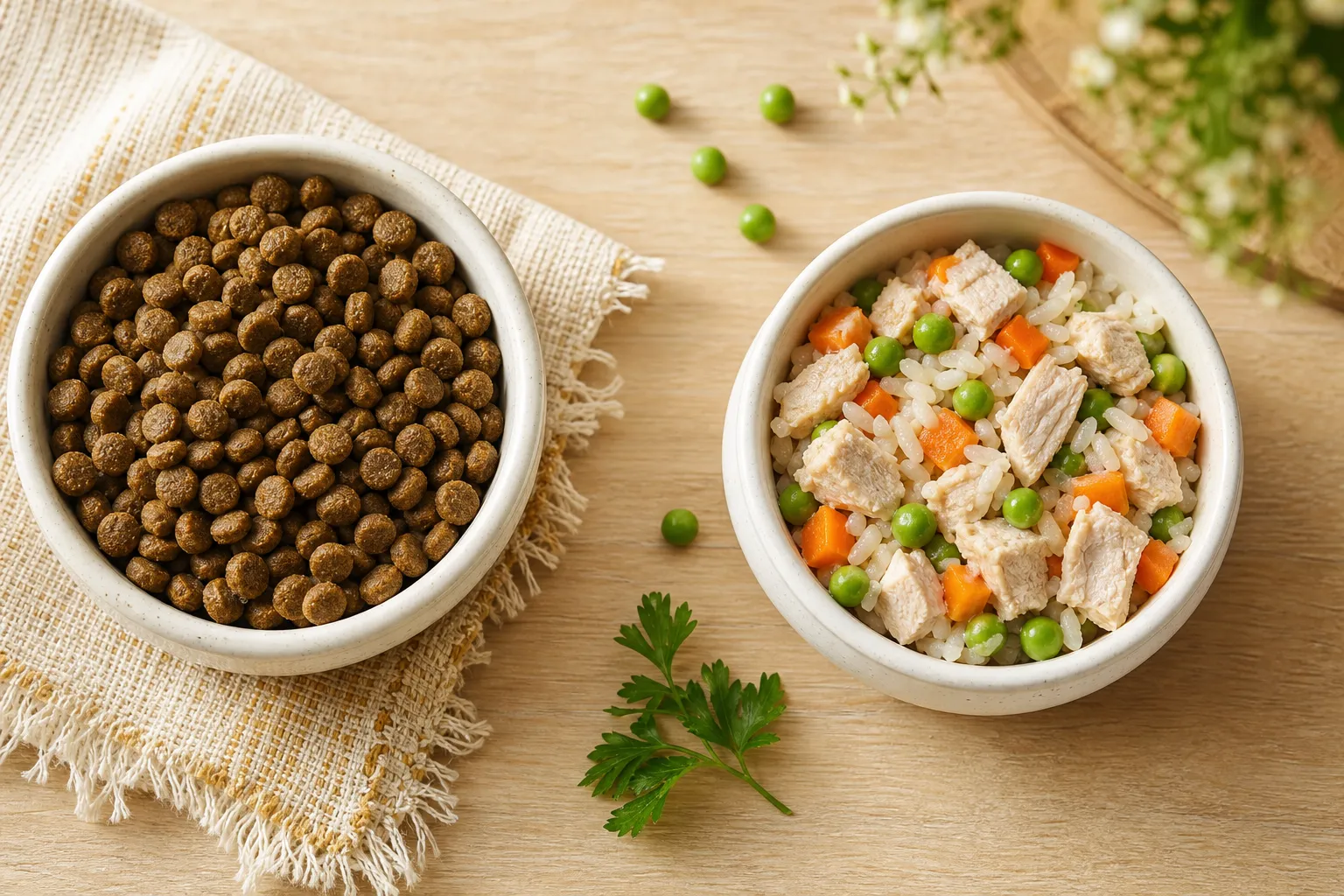
What is the real difference between fresh dog food and kibble?
The real difference is processing and water: kibble is extruded and dried to about 10% moisture, while fresh food is gently cooked, frozen or chilled, and around 70% water. Almost everything else you notice after a switch follows from those two facts.
Kibble is made by forcing a cooked dough through an extruder, then drying and coating it. Research on canine diets describes extrusion temperatures of 110-150 °C (230-300 °F) (Tran, Wageningen University, 2008). Fresh food is cooked in batches at lower heat, portioned and frozen, so it keeps its water and looks like food you'd recognize. Raw food skips cooking altogether, which brings its own risks; see is raw dog food safe?
| Kibble | Fresh (gently cooked) | |
|---|---|---|
| Processing | Extruded at high heat and pressure, then dried | Cooked at lower heat, then frozen or chilled |
| Water content | About 10% | About 70% |
| Calories per cup | High: small bowl | Low: big bowl for the same calories |
| Storage | Pantry, months once sealed | Freezer, then fridge for a few days |
| Portioning | You scoop and estimate | Usually pre-portioned to a calorie target |
| Completeness | Only if the AAFCO statement says so | Only if the AAFCO statement says so |
Moisture and calorie figures are typical ranges; always check the guaranteed analysis on the food you buy.
Does a dog digest fresh food better than kibble?
Yes, in the small studies we have, fresh and mildly cooked diets were more digestible than extruded kibble. Two University of Illinois trials are the core evidence, and both have real limits.
| Study | Dogs and diets | Main finding | Limits |
|---|---|---|---|
| Do et al., 2021 | 12 beagles; kibble vs one fresh refrigerated and two fresh human-grade diets, 4 weeks each | Kibble-fed dogs ate more to hold their weight and produced 1.5-2.9x more stool | One breed, short trial, funded by a fresh-food company |
| Algya et al., 2018 | 8 adult dogs; kibble vs two mildly cooked (roasted, refrigerated) diets and a raw diet | Mildly cooked diets had higher protein and fat digestibility than kibble | Small sample; funded by Freshpet, whose diets were tested |
Both studies measured what goes in and what comes out over weeks. Neither measured lifespan, disease rates or long-term health, and no study has shown fresh food changes those. The 2021 trial's funding is reported by Veterinary Practice News.
Why does a fresh-food bowl look so much bigger?
Because fresh food is mostly water, it carries far fewer calories per gram, so the same calories fill a much bigger bowl. The example below uses two illustrative labels, not specific brands.
| 50 lb (22.7 kg) neutered adult | Kibble example | Fresh example |
|---|---|---|
| Label: protein / fat / moisture | 26% / 16% / 10% | 11% / 7% / 72% |
| Calories | 3,600 kcal/kg | 1,300 kcal/kg |
| Protein, dry-matter basis | 28.9% DM | 39.3% DM |
| Protein per 1,000 kcal | 72 g | 85 g |
| Food for 1,164 kcal a day | 323 g | 895 g |
| Water in that food | 32 g | 645 g |
Daily calories from RER x 1.6 for a neutered adult. Label values are illustrative; swap in your food's guaranteed analysis.
Two things jump out. First, “11% protein” on a fresh label is not low: on a dry-matter basis it is 39.3%, well above kibble's 28.9% and far above AAFCO's adult minimum of 18% DM. Our guide to reading a dog food label walks through that conversion.
Second, the fresh bowl weighs nearly 2.8x as much for the same energy. That is why you can't swap cups for cups. Convert by calories, using our fresh feeding guide.
The Farmer's Dog - Best overall fresh dog food
50% off first box + free treats
- Personalized meal plans for your dog's needs
- Gently cooked fresh food
- Formulated by board-certified nutritionists
- Cancel anytime
- Custom portions
- Ships frozen
Best overall fresh dog food
50% off first box + free treats
- Personalized meal plans for your dog's needs
- Gently cooked fresh food
- Formulated by board-certified nutritionists
- Cancel anytime
- Custom portions
- Ships frozen
Will your dog drink less water on fresh food?
Probably, and that's expected. In the example above, the fresh diet delivers about 645 g of water a day against 32 g from kibble, so less needs to come from the water bowl.
Total intake is what matters, not the bowl alone. Keep fresh water out at all times. A sudden, large change in thirst on any diet is worth a call to your vet.
How will your dog's stool change after switching?
Expect smaller, firmer stools once your dog adjusts, and possibly a softer few days during the switch. Smaller volume is the digestibility finding above, showing up in your yard.
Switch over about 10 days, moving roughly a quarter of the calories at a time; our transition plan lays out each day. Dogs with a history of stomach trouble should go slower; see fresh food for sensitive stomachs.
Does kibble clean a dog's teeth better than fresh food?
No, not in any meaningful way. Most kibble shatters as soon as your dog bites it, so there is very little scraping action on the tooth surface.
Only specific dental diets and chews with tested claims have shown a reduction in plaque or tartar; the Veterinary Oral Health Council lists the ones that met its standard (VOHC). Fresh food doesn't clean teeth either. Brushing and regular dental checks do the real work on either diet.
Do picky dogs really eat fresh food better?
Owners say so often. Of the 282 Trustpilot reviews we read for our brand reviews, 39 (14%) mention a picky, finicky or fussy eater, more than mention price (33). That is owner testimony, not a trial, and the reviews sit on the brands' own profiles. Still, it matches what feeding trials can't easily measure: dogs choose taste and smell.
You can read every one of those reviews on our Spot & Tango and The Pets Table review pages. For a dog that walks away from its bowl, see our best food for picky eaters.
What stays the same whether you feed fresh or kibble?
Completeness and calories stay the same. A food is only complete and balanced if its AAFCO nutritional adequacy statement covers your dog's life stage, and that is true of a $5 bag and a $15 box alike.
Calories still decide weight. Vets rated 59% of US dogs overweight or obese in the Association for Pet Obesity Prevention's 2022 survey (APOP, 2022), and overfeeding fresh food adds weight as surely as overfeeding kibble. If weight is your goal, start with fresh food for weight management.
Should you switch your dog from kibble to fresh?
Switch if your dog is picky, needs tight portion control, or you want the digestibility and moisture benefits and the cost fits. Stay with a complete kibble if budget or freezer space rules fresh out; your dog is not missing a proven health benefit.
The middle path works well: replace about 25% of calories with fresh food (fresh toppers, mixed feeding). For the cost question, read is fresh dog food worth it? To pick a brand, start with our 2026 ranking or the head-to-head The Farmer's Dog vs Ollie, scored with our published rubric.

Ollie - Best for mixing fresh and baked
70% off 1st box + free gift
- Made with human-grade ingredients
- Vet-formulated & personalized meals
- 100% satisfied or money-back guarantee
- Cancel anytime
- Custom portions
- Frozen or dry
Best for mixing fresh and baked
70% off 1st box + free gift
- Made with human-grade ingredients
- Vet-formulated & personalized meals
- 100% satisfied or money-back guarantee
- Cancel anytime
- Custom portions
- Frozen or dry